LLM visibility tracking measures whether AI engines include, recommend, cite, and describe your brand correctly when people ask relevant questions. Instead of tracking a fixed Google ranking, it evaluates individual answer instances generated from prompts in systems such as ChatGPT, Gemini, Perplexity, and AI-powered search experiences.
That distinction matters. An AI assistant may mention a brand in a comparison but not recommend it. It may cite a respected review site rather than the brand’s own website. Or it may recommend the brand while describing its pricing, audience, or capabilities incorrectly. Effective AI visibility tracking separates those outcomes instead of treating every mention as a win.
What does LLM visibility tracking actually measure?
LLM visibility tracking is a form of AI search brand monitoring built around prompts, answers, citations, and narratives. The unit being measured is an answer generated in response to a specific query, not a keyword position or a page’s rank in a conventional results page.
A useful tracking program captures the answer itself, the engine used, the prompt, market or language settings, date, and the brands discussed. This gives teams a defensible record of what an answer engine said at a point in time, rather than a vague impression of whether the brand is “visible in AI.”
| Measurement | What it answers | Why it should stay separate |
|---|---|---|
| Brand inclusion | Did the AI answer mention the brand? | A mention can be neutral, negative, or incidental. |
| Recommendation rate | Did the engine present the brand as a suitable option? | Recommendation carries stronger decision-stage value than recognition alone. |
| Answer prominence | How early and how clearly did the brand appear? | Being listed first is different from appearing in a long final paragraph. |
| AI citation tracking | Which sources did the engine cite for claims about the brand? | A third-party citation and an owned-domain citation create different opportunities. |
| Narrative accuracy | Did the answer describe the brand correctly? | High visibility can still create commercial risk when the description is wrong. |
Competitive analysis belongs here too. AI share of voice is the proportion of relevant answer instances in which a brand appears compared with direct competitors. It is most meaningful within a stable prompt set, engine set, market, and time period. There is no universal “good” AI visibility score that applies equally to every category.
Why track your brand in AI-generated answers?
AI answers increasingly influence research before a customer reaches a website. For example, among U.S. consumers who had used generative AI for online shopping, 53% said they used it for product research, making recommendation and comparison prompts meaningful consideration-stage territory.
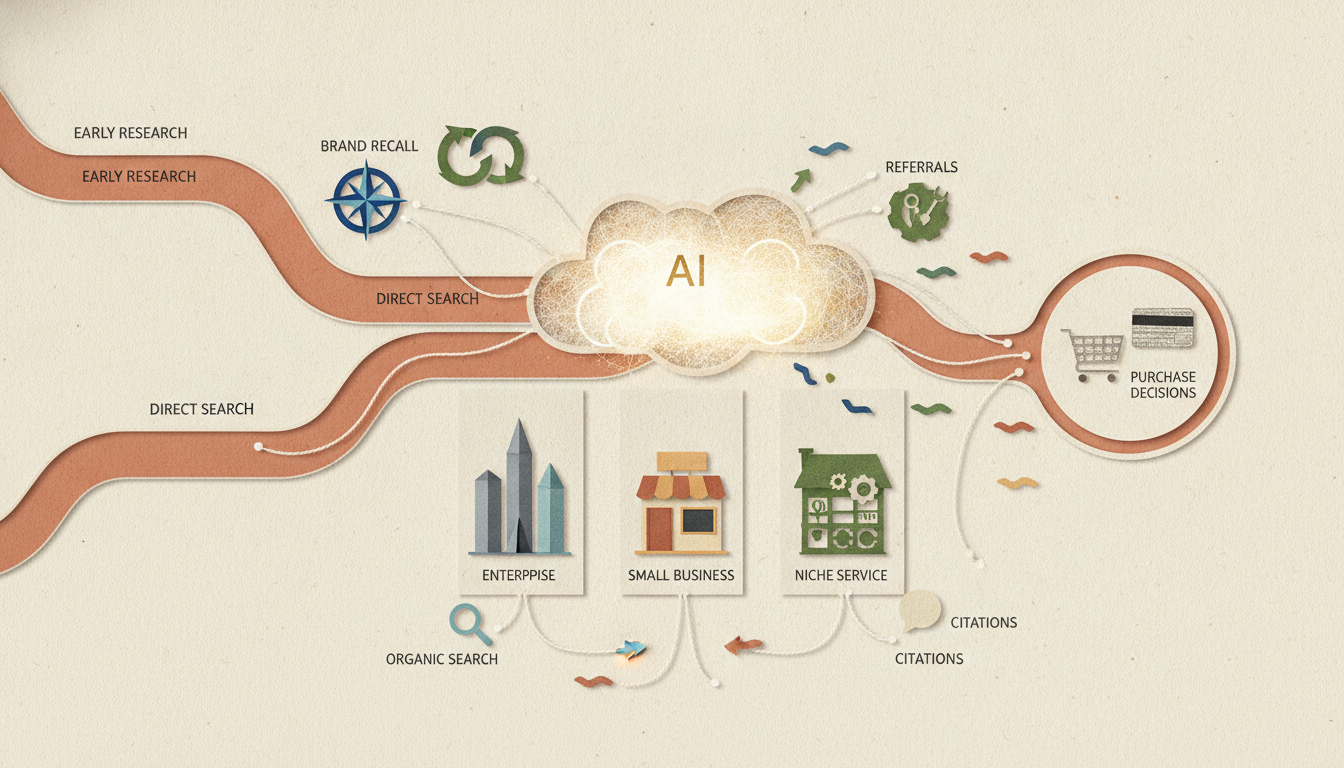
Traditional SEO still matters, but it cannot fully explain this journey. A user can receive a brand recommendation, form an opinion, and later search directly for the company without clicking an AI citation. AI search analytics should therefore sit beside organic visibility, referral traffic, branded-search trends, and conversion data—not be forced into one blended score.
For teams serving distinct verticals, segmentation is essential. A message that works for enterprise buyers may not surface in small-business prompts, so comparing AI visibility reports by industry can reveal whether the issue is broad awareness or a gap in a specific buying context.
How do you build a reliable prompt set without testing hundreds of queries?
A small team can begin with 24 to 36 carefully selected prompts. The goal is representation, not volume. Choose prompts that reflect how prospects frame needs before they know your brand, when they compare options, and when they evaluate risk.
Start with four prompts in each of these categories: category discovery, problem-solving, product comparison, recommendations, evaluation criteria, branded questions, and risk or objection questions. If your business operates across two priority markets, localize the most commercially important prompts rather than translating every query mechanically.
- Category: “What are the leading project management platforms for agencies?”
- Problem: “How can a distributed agency reduce missed client deadlines?”
- Comparison: “How does Brand A compare with Brand B for creative teams?”
- Recommendation: “Which platform should a 30-person agency choose for project planning?”
- Evaluation: “What should agencies look for when choosing project management software?”
- Branded: “Is Brand A suitable for enterprise workflow management?”
- Risk: “What are the limitations of Brand A?”
Run each priority prompt three times per engine during a measurement cycle. Three repetitions are not a guarantee of statistical certainty, but they are a practical minimum for spotting unstable answers and preventing one unusually favorable or unfavorable response from driving a decision. For a small team, a monthly full run plus a weekly check of six to ten high-intent prompts is usually more useful than a sprawling quarterly exercise.
Keep prompt wording fixed for trend reporting. When a new phrase appears in customer calls or search-query data, add it as a separate test rather than quietly replacing an existing prompt. This creates a clean baseline for ChatGPT visibility tracking and avoids confusing a changed question with a changed result.

Use a transparent scorecard, not a black-box visibility number
Vendor-generated scores can be useful dashboards, but teams should be able to explain their own calculations. A transparent scorecard makes discussions with leadership, content teams, and agencies much easier because every point can be traced back to observed answer instances.
One practical approach is to calculate a weighted score from five components: inclusion, recommendation, prominence, citation quality, and narrative accuracy. Assign weights based on the business objective. A consumer brand focused on discovery may give more weight to inclusion and prominence; a B2B company with a long evaluation cycle may prioritize recommendation, accurate positioning, and high-quality citations.
- Define each event in writing: for example, “recommended” means the engine explicitly presents the brand as a fit for the stated use case.
- Set a simple scoring rule for every answer instance, such as 0 for absent, 1 for mentioned, and 2 for recommended.
- Record prominence separately, such as first option, early list position, later mention, or footnote-level mention.
- Audit narrative claims against approved product, pricing, audience, and availability information.
- Publish the formula, weights, prompt list, engines, sampling dates, and exclusions with every report.
The formula does not need to be complicated. What matters is consistency. A score based on the same prompts, repetition schedule, markets, and competitors can show direction over time. A score without documented inputs cannot reliably tell you whether performance changed or measurement changed.
What should happen after a tracking result?
Generative engine optimization measurement becomes valuable only when it leads to a clear action. Different patterns point to different underlying problems, and treating them all as “create more content” wastes time.
| Tracking pattern | Likely interpretation | Practical next action |
|---|---|---|
| High mention rate, low recommendation rate | The brand is known but not framed as a strong fit. | Strengthen use-case pages, comparison evidence, proof of fit, and clear audience positioning. |
| Strong visibility, inaccurate descriptions | Sources available to the model contain stale, unclear, or conflicting information. | Correct owned pages, update structured product information, and address repeated false claims directly. |
| Frequent third-party citations, few owned citations | External sources establish awareness, while owned pages may be weak or inaccessible for the claim. | Create authoritative first-party pages that directly answer the cited question and support specific claims. |
| High prominence, weak referral or conversion quality | The answer creates exposure, but the audience or landing experience may be mismatched. | Review prompt intent, cited landing pages, message continuity, and post-visit behavior. |
For example, a company cited in “best tools” articles may appear repeatedly but still lack first-party citations for implementation, security, or pricing questions. That is not simply an SEO gap. It is a source-authority gap. Teams can get your business cited in ChatGPT, Perplexity, and Gemini by building pages that answer a defined claim fully, rather than publishing broad promotional copy that gives answer engines little evidence to use.
Narrative errors deserve a faster response than low visibility. If an engine says your product lacks a feature it has, serves the wrong customer segment, or is unavailable in a market where it operates, document the exact answer, supporting citations, and recurring prompt. Then correct the most authoritative owned sources first. The objective is not to “train” a model directly; it is to improve the factual material that retrieval and source selection may draw upon.
How should citation review work in practice?
AI citation tracking is not complete when a team counts links. Review each citation as evidence: identify whether the source is owned or third-party, capture the cited URL and its placement, and assess whether the page actually supports the claim made in the answer.
A cited page can be problematic even when it belongs to your domain. A shallow feature page may be cited for pricing. An outdated help article may be used to describe a discontinued plan. A regional page may be surfaced for the wrong market. Citation quality is therefore a content-governance issue as much as an answer engine optimization issue.
Build a citation register with the prompt, engine, answer date, claim, cited domain, URL, source type, citation position, and evidence assessment. When the register reveals recurring weak pages, prioritize those pages for revision. Guidance on how to optimize content for ChatGPT answers is most useful when applied to these observed claim gaps rather than as a generic content checklist.
How do AI results connect to traffic and revenue?
Visibility is not traffic, and traffic is not revenue. Still, AI-referred visits may behave differently enough to deserve their own reporting view. Similarweb found that U.S. desktop generative-AI referrals to transactional sites converted at about 7%, versus roughly 5% from Google, while visitors averaged 15 minutes and 12 pages per visit; the AI referral comparison is a useful reminder to evaluate engagement and outcomes, not clicks alone.
Tag known AI referral sources where analytics permits, but accept attribution limits. Some AI exposure creates no referral, and some users return through direct or branded search later. Report observed referral sessions and conversions separately from prompt-level visibility trends. That separation protects the analysis from claims the data cannot support.
Make LLM visibility tracking an operational discipline
The strongest LLM visibility tracking programs do not chase every answer fluctuation. They maintain a stable prompt panel, repeat critical tests, preserve answer evidence, and investigate meaningful patterns: a competitor repeatedly recommended for a use case, a recurring inaccurate claim, or a citation source that shapes the category narrative.
Start small enough to run the process consistently. A documented set of 24 to 36 prompts, three runs for priority queries, a transparent scorecard, and a monthly action review will produce better learning than hundreds of unstructured screenshots. From there, expand coverage only when a market, language, product line, or buyer journey genuinely requires it.
AI visibility tracking earns its place beside SEO when it answers a practical question: what are AI engines telling potential customers about this brand, and what evidence is causing that answer? That is the standard worth monitoring—and improving.

Related Posts