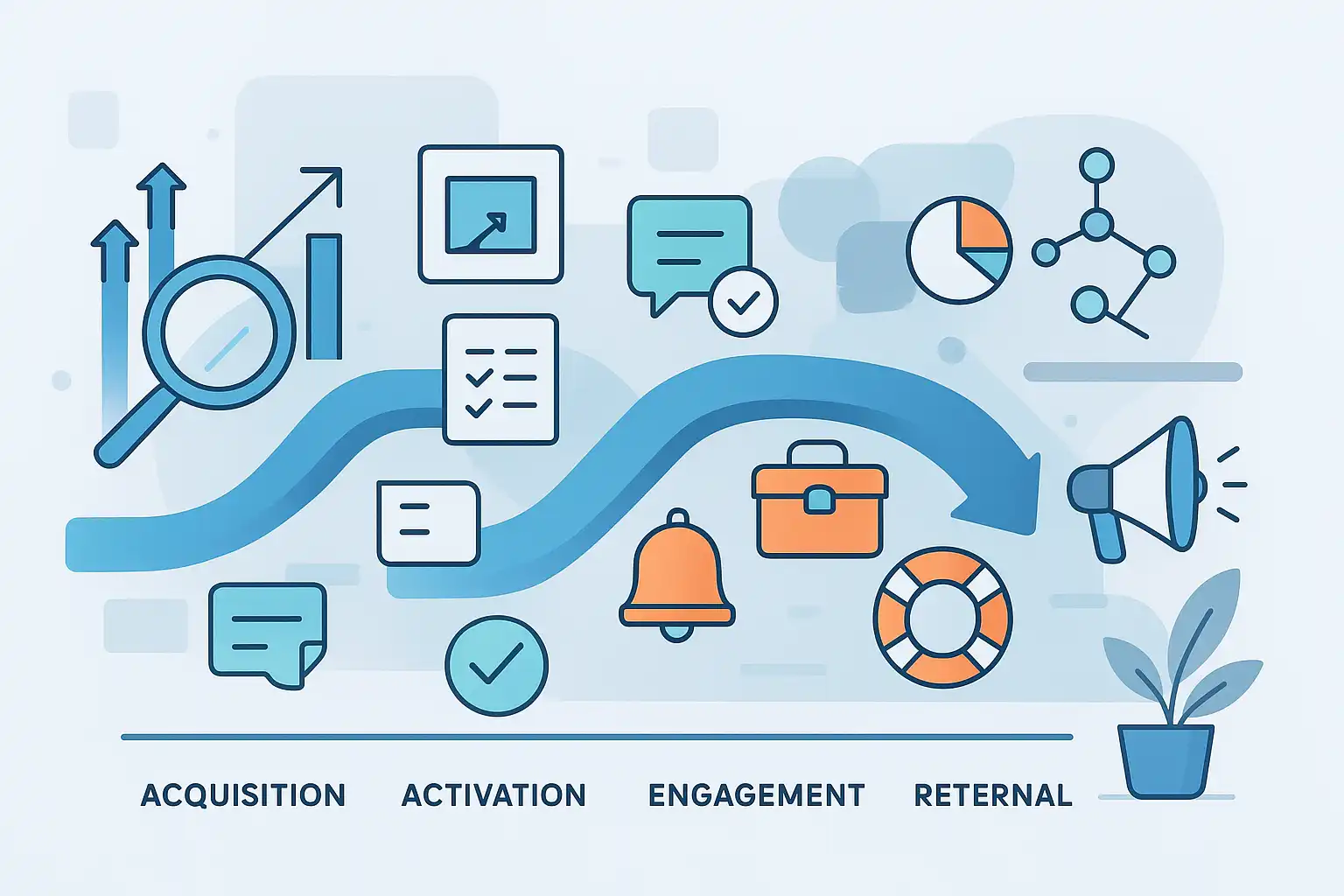
If you want your SaaS startup to grow, thrive, and keep customers for the long haul, you need a solid plan for how you’ll use content at every step. A smart content strategy for SaaS startups is not just about writing blog posts or sending out emails. It’s about guiding potential users through every stage, from discovering your brand to staying loyal—and even telling their friends.
So, what makes a content strategy work for SaaS startups? It means matching your content with the SaaS customer lifecycle: Acquisition, Activation, Engagement, Retention, and Referrals. Each stage requires its own types of content, channels, and messages. Let’s break that down immediately—so you can start applying these principles to your SaaS business today.
What are the key components of a winning SaaS content strategy?
The foundation of any effective content strategy for SaaS startups lies in addressing all five customer lifecycle stages. If you want to nurture lasting customer relationships, each content piece should have a role that fits one of these stages:
- Acquisition: At this stage, your content should help new users find you. Use resources like SEO-focused blog articles, landing pages, paid ads, and social media posts. Your message should focus on solving problems, demonstrating value, and building trust.
- Activation: Here, content is about that all-important first impression. Use onboarding guides, checklists, and step-by-step tutorials to get users to their ‘aha moment’—the point where they truly see your product’s value.
- Engagement: Keep users active with helpful resources: feature announcements, webinars, in-app tips, and regular email updates. The aim is to guide them deeper into your product, making it part of their routine.
- Retention: Focus on content that keeps users satisfied and reduces churn. Examples include knowledge bases, troubleshooting guides, customer success stories, and targeted offers. This is where ongoing value matters most.
- Referrals: Encourage users to share your product. Provide shareable content, referral program details, and customer advocacy resources so users can easily recommend you to others.
By covering each stage, your strategy ensures users don’t fall through the cracks. For example, consider how a customer who finds you through a helpful SEO article (acquisition) is more likely to stick around if you provide clear onboarding content (activation) and engaging follow-up materials (engagement).
How do you tailor content at every stage of the SaaS customer journey?
Content tailoring means matching your message—and the format—to where the user is in their journey. Customers have different needs at different times, so a one-size-fits-all approach won’t work. Here’s how you can adapt content for each phase:
- Acquisition:
- Use blog posts, guides, and case studies that address common pain points.
- Publish thought leadership on channels your target audience frequents.
- Make use of SEO best practices so your content appears when users search for solutions.
- Run paid campaigns on social media that highlight your product’s unique benefits.
- Try email marketing with lead magnets—free eBooks, checklists, or templates relevant to your audience.
- Activation:
- Create welcome emails and product tours that help new users get started smoothly.
- Develop onboarding checklists and quick-start videos to guide users to their first success.
- Personalize onboarding experiences based on user role or industry.
- Engagement:
- Send regular product updates, tips, or usage suggestions.
- Offer webinars and live Q&As to demonstrate advanced features.
- Use in-app messages or pop-ups to highlight underused features or announce improvements.
- Retention:
- Maintain a robust help center and self-service resources.
- Survey users about their experience (e.g., Net Promoter Score) and respond to their feedback.
- Send personalized offers for upgrades or cross-sells based on user activity.
- Share customer stories that demonstrate your product’s long-term benefits.
- Referrals:
- Promote customer referral programs with clear instructions and rewards.
- Encourage satisfied users to review your service on third-party sites.
- Share easy-to-forward case studies or testimonials users can show to friends.
If you want to deepen your understanding, reviewing an content strategy example can clarify how SaaS startups align messaging across the funnel to nurture users from first click to loyal advocate.
Adjusting content like this isn’t just a best practice; it’s the modern standard in fast-growing SaaS.
Which channels and formats are most effective for SaaS content marketing?
Every SaaS audience is different, but certain channels and content types consistently drive results across the industry. Let’s look at options you can choose from, depending on your resources and target market:
- Blog Articles: SEO-optimized posts can answer key questions, rank for target keywords, and build authority.
- Landing Pages: Each core feature or benefit can have its own optimized page for conversions.
- Email Campaigns: Segmented communications based on user actions increase open and conversion rates.
- Webinars & Live Demos: These foster real-time engagement and drive deeper product understanding.
- Help Centers & Knowledge Bases: These empower users to solve problems without waiting on support.
- Videos & Product Tours: Short, focused clips help users quickly grasp your product’s value.
- Case Studies & Customer Stories: Real-world results are persuasive for prospects who want proof before buying.
- Social Media Content: Great for announcements, customer spotlights, and engaging a wider audience.
- In-app Messages: Timely, contextual tips or alerts guide users toward successful actions.
It’s common for SaaS startups to combine several of these formats. For example, a new feature might be announced via a blog post, demonstrated in a video, explained in the knowledge base, and promoted through email and in-app notifications.
For a deeper dive into growing SaaS funnels, check the Funnel Optimization for Conversions guide, where you can see how coordinated content unlocks steady sign-up growth.
How do you measure SaaS content strategy effectiveness?
Knowing whether your content is working is as important as creating it. For SaaS content strategies, tracking the right metrics at both the acquisition and retention stages is crucial. Here are the most important metrics to monitor:
| Stage | Key Metrics |
|---|---|
| Acquisition |
|
| Activation & Engagement |
|
| Retention |
|
| Referrals |
|
Using tools like Google Analytics, Mixpanel, or Segment allows you to track these metrics closely. If you want to get started at an entry level, resources such as the entry level content strategy overview can show how to set up basic dashboards that grow with your company.
Reviewing metrics regularly helps you spot which content types are hitting the mark and where you need to adjust focus—whether that’s more how-to guides, better onboarding, or an updated referral program.

What common mistakes do SaaS startups make in content marketing?
Building a content strategy for SaaS startups has its pitfalls. Some of the most frequent mistakes include:
- Focusing only on acquisition and neglecting activation, engagement, and retention content.
- Failing to define clear goals or metrics for each content piece.
- Using overly technical jargon and not writing for the reader’s level.
- Underestimating the importance of onboarding content and resources.
- Ignoring customer feedback and not updating content to reflect product changes.
- Not aligning content with the customer journey, causing drop-offs after sign-up.
- Over-promoting features instead of benefits or outcomes.
- Leaving referral and advocacy programs as an afterthought.
One way to avoid these errors is to regularly audit your content and customer journey. Consider mapping out your entire funnel and identifying gaps at each stage. For a straightforward approach to business content, explore the Simple B2B Content Strategy framework, which many SaaS marketers use as a reliable guide.
How do you get started building a content strategy for your SaaS startup?
Whether you’re launching your first SaaS or scaling an existing platform, these steps will help you build a content strategy that works from acquisition to retention:
- Define your audience and their pain points. Create detailed buyer personas by talking to real users and support teams.
- Map customer journeys for each persona—including every touchpoint from awareness to referral.
- Set clear objectives for each lifecycle stage. Are you aiming for more sign-ups, higher activation rates, or increased referrals?
- Choose channels and content formats that best reach and serve your users.
- Plan a content calendar that covers all five lifecycle stages, not just acquisition.
- Assign responsibilities—designate team members to own stages, content types, or channels.
- Use your analytics setup to track key metrics (see the above table) and adjust based on performance.
- Iterate regularly. Gather feedback, review funnel drop-off points, and refine your approach.
It helps to start small and build on wins. For example, if a “getting started” guide boosts activation, consider making more onboarding materials or offering a live Q&A for new users. Over time, you’ll see which content types move the needle at each stage and can focus resources there.
What tools and resources help streamline SaaS content strategy?
Many SaaS-specific tools make the entire content process smoother—whether you’re a team of one or growing fast. Some essentials include:
- Content Planning: Trello, Asana, or Notion to manage calendars and workflows.
- SEO Analysis: Ahrefs, SEMrush, or Moz for keyword and competitor research.
- Email Campaigns: Mailchimp, ConvertKit, or Customer.io for automated communication flows.
- Analytics: Google Analytics, Mixpanel, Amplitude for website and product usage tracking.
- User Feedback: Typeform, SurveyMonkey, or Intercom for surveys and direct insights.
- Help Center Tools: Zendesk, Help Scout, or Freshdesk for self-service resource hubs.
- Video Creation: Loom, Wistia, or Vidyard for easy-to-watch onboarding and explainer videos.
There’s no one-size-fits-all stack. Pick the tools that suit your team’s expertise and your audience’s needs. Efficiency in planning and measuring content frees up more time to get creative—and stay ahead of competitors.
FAQ
How often should you update your SaaS content strategy?
Ideally, review your content strategy every quarter. SaaS products evolve quickly, so your content must keep pace with feature changes, user feedback, and new market trends. Regular updates help ensure your content always matches your customers’ needs.
What is the best way to align content with both sales and customer support teams?
Involve sales and support early in your strategy. Get their input on customer pain points and common questions, then use their feedback to build FAQ resources, onboarding guides, and content that addresses real-world problems. Ongoing collaboration ensures consistent messaging and fewer content gaps.
Should SaaS startups focus more on blog posts or product-focused content?
Balance is key. Early-stage SaaS companies often rely on SEO blog posts to drive initial discovery and traffic, but as users onboard and engage, product-focused content like tutorials and success stories become essential for keeping them happy and loyal. Adapt your content mix based on your current goals and user feedback.
How do you encourage happy customers to create referrals and testimonials?
Make it easy for customers to share positive experiences. Offer referral rewards, send timely requests for testimonials after success moments, and provide templates they can quickly use. Celebrate customer wins publicly (with permission), and always show appreciation for referrals—it’s a powerful way to grow organically.

Related Posts