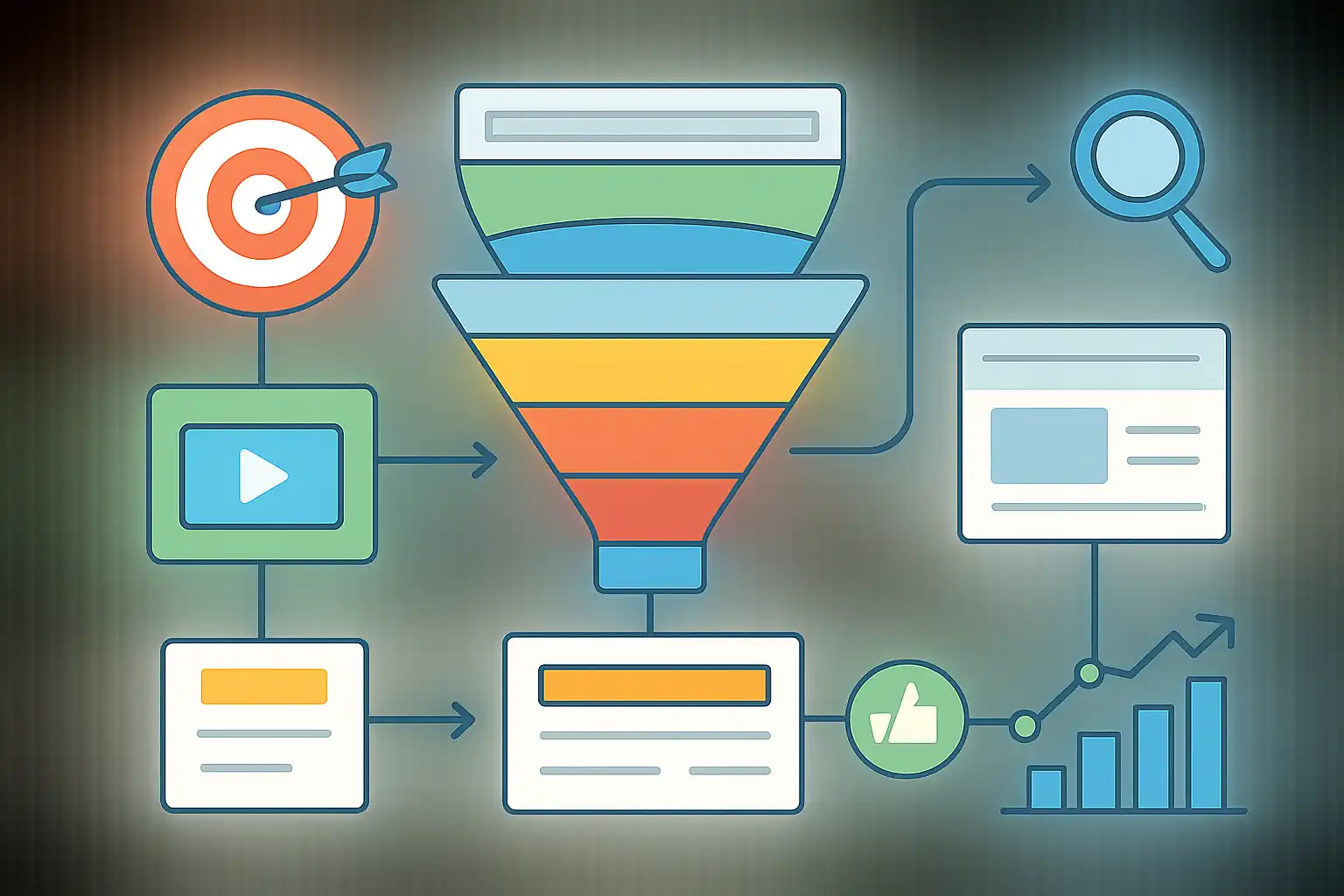
If you want more leads turning into loyal customers, sales funnel optimization is essential. In simple terms, it means improving every stage of your customer journey so more visitors become buyers — and buyers become repeat customers. When each funnel stage works well, potential customers move smoothly from awareness to purchase and beyond. When they don’t, you lose revenue at every step.
This guide covers proven strategies, a step-by-step optimization process, how to use data to identify bottlenecks, the metrics that matter, and the tools that make it all measurable.
What is a sales funnel and why optimize it?
A sales funnel is a roadmap that guides prospects from first discovering your business to making a purchase — and hopefully coming back again. Most funnels follow five key stages:
- Awareness (TOFU): Prospects first discover your brand.
- Interest: They engage more deeply and learn about your offer.
- Desire (MOFU): They evaluate your solution and build confidence.
- Action (BOFU): They decide to buy or sign up.
- Re-engagement and Loyalty: Post-purchase nurturing turns buyers into repeat customers and advocates.
Most websites lose potential customers at every one of these stages. Fixing bottlenecks and improving engagement at each step boosts your overall conversion rate, increases revenue, and builds stronger customer relationships. The process is ongoing — continuous improvement helps you adapt as customer behavior and competition evolve.
How to optimize each stage of the funnel
1. Awareness — Attract the right visitors
Use SEO, social media, paid ads, and helpful content to reach your target audience. Create content that answers common questions in your field — this builds trust and draws in qualified visitors. The goal here is getting attention from the right people, not just anyone.
2. Interest — Educate and nurture
Keep prospects engaged with in-depth guides, case studies, webinars, and downloadable resources. Email marketing is especially powerful here. Segment your audience and send content tailored to their specific pain points and stage. Personalized communications keep leads moving toward a decision.
3. Desire — Build confidence and urgency
Show prospects why your solution is the best choice. Use customer testimonials, reviews, social proof, and demos. Highlight key benefits and differentiate clearly from competitors. A limited-time offer or bonus can add urgency that tips prospects toward action.
4. Action — Remove every barrier to conversion
Make it as easy as possible to buy or sign up. Use clear, action-oriented CTAs; short, simple forms; transparent pricing; and a frictionless checkout. Address last-minute doubts with live chat, FAQs, or trust badges. Secure payment icons and a clear return policy reassure buyers at the critical moment. According to Nielsen Norman Group research, careful form design has a huge impact on how quickly users can complete a form accurately — and even small friction points significantly reduce conversion rates.
5. Re-engagement and Loyalty — Turn buyers into fans
Your work isn’t done after the sale. Use post-purchase emails, loyalty programs, and exclusive offers to bring customers back. Encourage reviews and feedback. By staying top-of-mind with ongoing value, you convert one-time buyers into repeat customers and brand advocates.
Step-by-step sales funnel optimization process
- Define goals for each funnel stage. Decide what success looks like at every phase — newsletter sign-ups, demo requests, product purchases, repeat orders.
- Map the customer journey. Visualize how prospects move from first contact to loyal customer. Identify all touchpoints: website, emails, ads, social media.
- Analyze user behavior. Use analytics to track where visitors drop off. Heatmaps, session replays, and funnel reports reveal patterns you can’t see in raw data alone.
- Identify bottlenecks and friction points. Look for stages where conversion rates are low or where users abandon the process — a confusing form, a slow page, unclear messaging.
- Test and optimize. Run A/B tests on landing pages, CTAs, email subject lines, and page layouts. Change one thing at a time to isolate what’s actually making a difference.
- Segment and personalize. Divide users by demographics, behaviors, or interests and tailor your content for each group. The more relevant the message, the higher the conversion.
- Monitor results and repeat. Continuously measure key metrics and use findings to keep improving. Funnel optimization is never “done.”
For a deeper dive into stage-specific tactics, this guide on turning funnel stages into conversions walks through how each step connects to measurable revenue outcomes.
How data analysis identifies bottlenecks
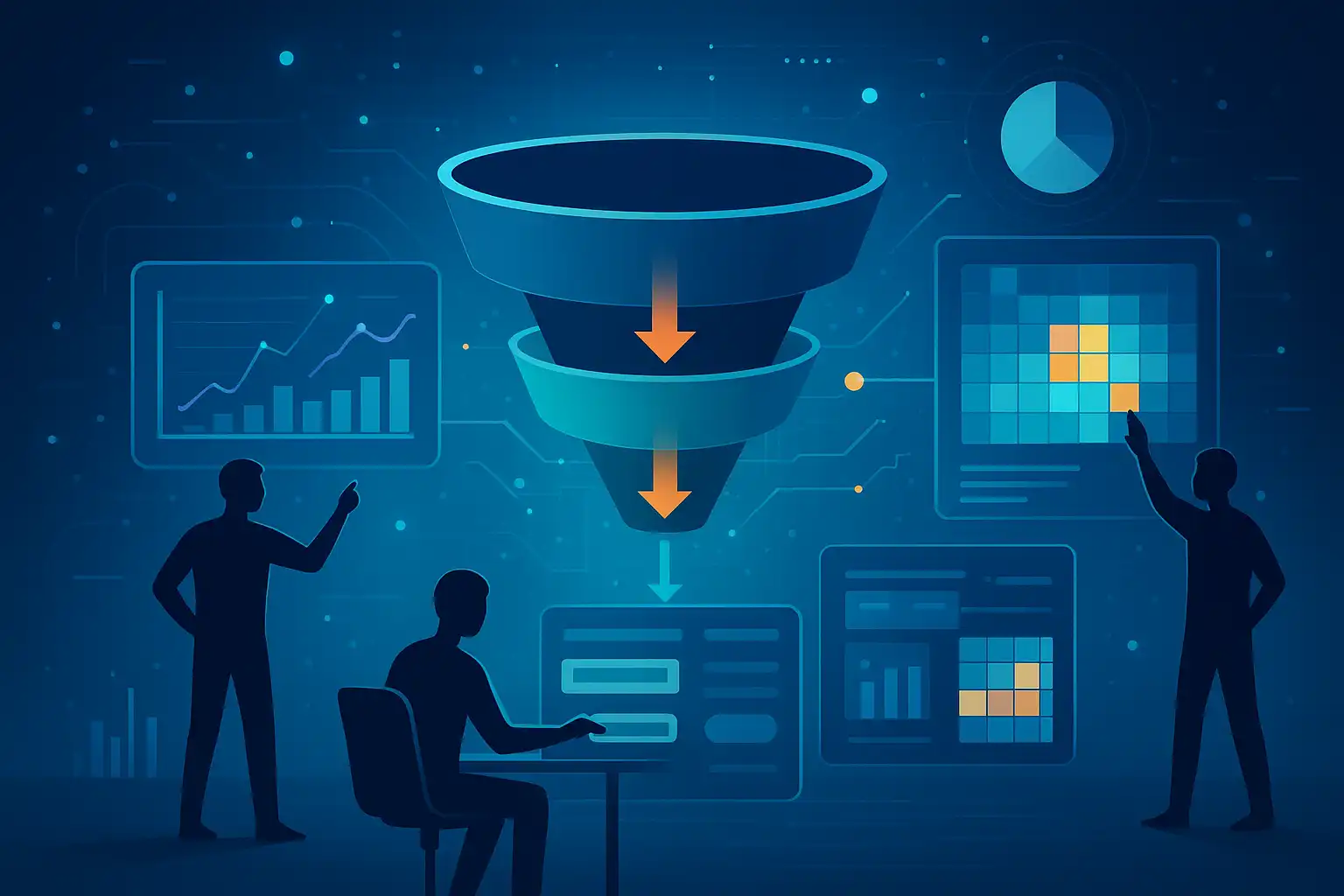
Data is the foundation of effective funnel optimization. By tracking what visitors do at each stage, you see exactly where things are working — and where they’re not.
Look for sharp drops in conversion rates between stages. If lots of people click your ad but few fill out your signup form, the form is likely too long or confusing. If visitors view your product page but don’t buy, they may need more information, social proof, or reassurance.
Once you identify a sticking point, test a new version of that page or element. Use heatmaps and session recordings to see how people actually interact with your funnel — these tools reveal pain points that raw numbers alone don’t show.
Examples of data-driven funnel improvements:
- High checkout abandonment → simplify the form, clarify shipping costs, add trust signals → completion rate improves. Baymard Institute’s research shows the average cart abandonment rate is around 70% — and most of that loss is recoverable through better checkout design.
- Blog drives traffic but few newsletter sign-ups → add a lead magnet → email list grows.
- Product page has high bounce rate → add customer reviews and a product video → conversions increase.
Key metrics to track
Stop tracking vanity metrics and focus on what actually measures funnel health:
- Conversion rate: The percentage of visitors who take a desired action at each stage.
- Click-through rate (CTR): How many people click your ads or links compared to those who see them.
- Cost per acquisition (CPA): How much you spend to acquire each new customer.
- Lifetime value (LTV): The total value a customer brings over their entire relationship with your business.
- Average order value (AOV): The typical amount spent per purchase.
- Engagement rate: How often users interact with your emails, pages, or products.
- Drop-off rate by stage: Where in the funnel are you losing the most people?
Review these at least monthly. For active campaigns, weekly checks help you catch problems before they compound.
Tools for sales funnel optimization
Analytics and tracking:
- Google Analytics 4 — funnel analysis, audience tracking, user flow visualization
- Mixpanel / Amplitude / Heap — event-based user journey analysis and conversion tracking
- Hotjar / Microsoft Clarity / Crazy Egg — heatmaps, session replays, behavior analytics
Testing and landing pages:
- Unbounce / Leadpages — landing page building and A/B testing
- Optimizely / VWO — multivariate testing and experimentation
CRM and automation:
- HubSpot / Salesforce — funnel visualization, lead scoring, and marketing automation
- Mailchimp / ActiveCampaign — email nurturing and segmentation
Conversion support:
- Drift / Intercom — real-time chat to answer questions and reduce drop-offs
- Pendo / Userpilot / Fullstory — product analytics and UX improvement
Common mistakes to avoid
- Not understanding your audience deeply enough — generic messaging fails to resonate with anyone specifically.
- Overlooking mobile optimization — many visitors browse and buy on phones; a slow or clunky mobile experience kills conversions.
- Too many steps or too much information too early — complexity causes drop-offs before the prospect is ready.
- Ignoring data or failing to act on test results — analysis without action is wasted effort.
- Only optimizing the bottom of the funnel — problems at awareness or interest stages starve the rest of the funnel.
- No post-purchase strategy — losing customers after the first sale wastes your acquisition investment.
If you want quick, actionable improvements to start with, this collection of practical tips for refining your funnel covers small changes that often deliver outsized results.

Funnel optimization is easiest to manage when you track the right metrics, improve the biggest bottlenecks first, and match your content to each stage of the customer journey.
- Conversion rates before and after each change
- Average time spent in each funnel stage
- Overall sales performance
- Changes in sales cycle length
- Repeat purchase and customer retention signals
| Optimization Area | What to Do | What Success Looks Like |
|---|---|---|
| Main Conversion Points | Focus first on landing pages and checkout. Test headlines, CTAs, and page layouts quickly. | Higher conversion rates, fewer drop-offs, and smoother movement toward purchase. |
| Funnel Review Cycle | Review active funnels at least monthly, and investigate immediately after campaign launches or sudden conversion drops. | Problems are found earlier, and the funnel keeps improving over time. |
| Benchmarking | Use industry benchmarks as context, but focus mainly on improving your own baseline. Typical website conversion rates often range from 2% to 5%. | Steady improvement against your own past performance, not just comparison with an industry average. |
| Post-Purchase Growth | Use follow-up emails, loyalty programs, exclusive offers, and personalized recommendations. | More repeat purchases, stronger customer relationships, and more brand advocates. |
- Awareness: blog articles and educational guides
- Interest and desire: case studies and webinars
- Decision: testimonials and product demos
- Loyalty: post-purchase email sequences

Related Posts