
A strong saas content marketing strategy does not start with a blog calendar. It starts with a business outcome, a buyer problem, and a clear path from content to action. That matters because content can look busy without creating revenue; in fact, Forrester’s finding that 85% of B2B marketers failed to connect content activity to business value is a useful warning for any SaaS team measuring success mainly through pageviews.
SaaS content marketing is the creation and distribution of blogs, videos, guides, landing pages, and related assets to attract, convert, and retain users for subscription software. The practical challenge is that SaaS buyers usually research for longer, compare alternatives more carefully, and involve multiple stakeholders. A CFO, an operator, and an end user may all evaluate the same product differently. Your strategy has to answer all three.
This guide gives you a working framework you can use immediately: choose the goal, define the audience, pick topics based on purchase intent and pain points, build the right content mix, set up production, and measure pipeline, conversion, and retention impact. If you already have traffic but weak demos, trials, or expansion, this is the reset.
What a SaaS content marketing strategy needs to do
Most teams know they need content. Fewer know what the content must accomplish at each stage of growth. A SaaS content strategy should reduce uncertainty for buyers, support sales conversations, and help existing customers get value faster.
- Attract the right audience with educational and search-driven content
- Convert that audience with use-case pages, comparison content, and feature education
- Retain customers with onboarding, adoption, and advanced workflow content
- Equip sales with assets that answer objections and clarify product fit
If your content does not move one of those jobs forward, it is probably filler. That is especially true in B2B SaaS content marketing, where every asset competes with internal meetings, demos, and vendor comparisons for buyer attention.
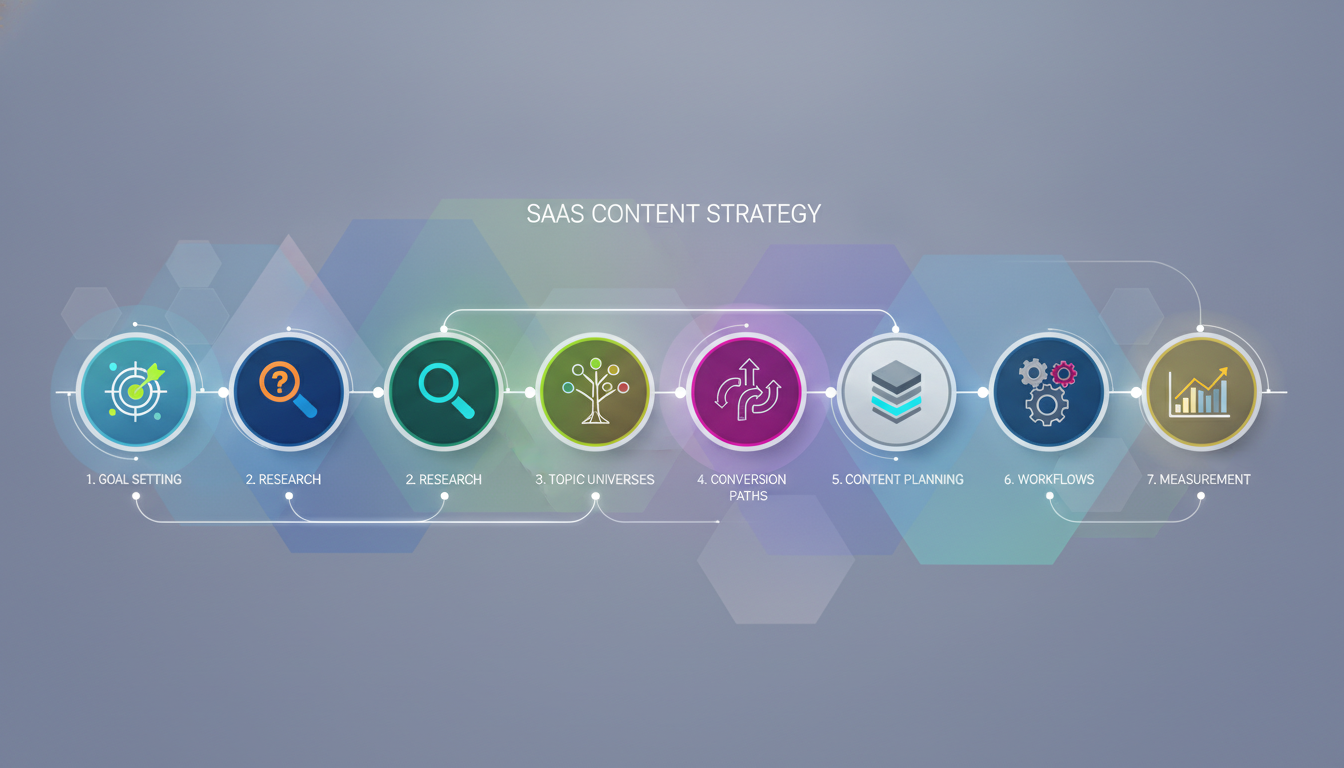
The 7-step framework
These steps are sequential on purpose. If you skip the foundation and jump to publishing, your SaaS content plan will produce activity without direction. Follow the order once, then refine each step in cycles.
1. Set one primary business goal for the next 6 months
Your strategy changes depending on company stage. Early-stage SaaS often needs sign-ups, demos, or category education. Growth-stage companies usually need more qualified pipeline and better conversion from existing traffic. Mature products often need retention, expansion, and content for multiple segments or product lines.
| Company stage | Primary content goal | Content to prioritize first |
|---|---|---|
| Early-stage | Validate demand and generate qualified sign-ups | Problem-aware articles, core product pages, use-case explainers |
| Growth-stage | Increase pipeline and conversion efficiency | Comparison pages, bottom-funnel SEO, sales enablement assets, case-led content |
| Mature SaaS | Improve retention and expansion | Adoption content, advanced workflows, integration pages, role-specific education |
This is where many teams overcomplicate things. Pick one primary metric and two supporting metrics. For example: demos booked as the primary metric, with assisted conversions and sales-qualified leads as supporting metrics. If you are sorting through strategic priorities, this companion guide on saas content strategy is useful because it frames acquisition and retention as different content systems, not one blended bucket.
2. Build your topic universe from buyer pain, not from keyword volume alone
This step is where a lot of SaaS SEO content goes wrong. Teams pull keywords from a tool, publish high-volume educational posts, and attract readers who will never buy. The better approach is to choose topics where pain, intent, and product relevance overlap.
Start with raw inputs from the market: demo call notes, sales objections, support tickets, customer onboarding questions, churn reasons, and community discussions. Those sources reveal the language buyers actually use. A head of RevOps may ask about implementation time, a team lead may worry about workflow change, and an individual user may care about speed or ease of use. Those are not just objections. They are topic seeds.
A practical topic filter
- List recurring customer pain points in plain language.
- Map each pain point to a buying stage: problem-aware, solution-aware, decision, or post-purchase.
- Ask whether your product has a credible role in solving that pain.
- Choose the search angle: educational, use-case, comparison, feature, or retention.
- Prioritize topics that can lead naturally to a demo, trial, or product action.
Example: if your SaaS helps customer success teams manage renewals, “how to reduce churn” is broad but still relevant, “customer renewal process template” is more specific and practical, and “Gainsight alternatives for mid-market teams” is high-intent comparison content. All three can belong in one SaaS content funnel, but they serve different moments in the buying journey.
That same principle applies when planning lead generation content: the strongest topics are not simply popular queries, but queries tied to expensive problems your product can credibly help solve.
3. Match content types to buying intent and stakeholder needs
SaaS buyers rarely move from one blog post to a purchase. They gather evidence in layers. Your buyer journey content should reflect that by addressing both stage and role.
- Top of funnel: definitions, frameworks, templates, workflow education, strategic guides
- Mid funnel: use-case pages, role-based pages, integration content, case-study-style proof, implementation explainers
- Bottom of funnel: comparison pages, alternative pages, feature pages, pricing explanation, objection-handling content
- Post-purchase: onboarding articles, product tutorials, advanced use cases, adoption playbooks
Now add stakeholder layers. If your buyers include operations leaders, practitioners, and procurement, create separate angles for each. A practitioner article might focus on workflow speed. A leader-focused page should emphasize standardization, visibility, and handoff reduction. Procurement usually wants security, implementation clarity, and contract confidence. Effective SaaS content creation does not flatten those needs into one page.
4. Fix the conversion path before scaling production
Publishing more into a weak website usually scales waste. Before expanding your SaaS content calendar, make sure the core journey works: homepage, product pages, feature pages, use-case pages, demo or trial flows, and clear calls to action. A strong foundation matters more than publishing frequency.
For example, if a blog post ranks for a high-intent workflow query but sends visitors to a generic homepage, the content is doing its job while the journey is not. The right path is usually tighter: article to relevant use-case page, use-case page to demo or trial, then follow-up assets that answer objections raised by sales.
This is also where product-led content earns its place. Product mentions should not interrupt the lesson. They should appear when the reader reaches the moment where software becomes the obvious next step. If the article teaches “how to automate monthly close handoffs,” the product mention belongs where the workflow becomes hard to manage manually, not in the second paragraph.
5. Turn topics into a balanced quarterly content plan
A working SaaS content plan needs range. If every asset is top-of-funnel education, pipeline suffers. If every asset is bottom-funnel comparison content, discoverability suffers. The mix should reflect your stage, your sales cycle, and the bottleneck you identified in step one.
A simple quarterly planning model
For a growth-stage company, a balanced quarter could look like this:
- 3 bottom-funnel assets: comparison pages, feature-led pages, competitor alternative pages
- 4 mid-funnel assets: use-case pages, role-specific guides, implementation content
- 3 top-funnel assets: category education, templates, strategic explainers
- 2 retention assets: onboarding or adoption content for current customers
That mix is not universal. An early-stage SaaS may lean more heavily into problem education and category framing. A mature SaaS may devote more effort to retention and expansion. Editorially, the useful rule is this: prioritize content closest to the current business bottleneck, then support it with adjacent pieces.
If you are building your planning rhythm, review external patterns carefully but do not imitate them blindly; broad industry roundups such as content marketing trends 2025 can spark ideas, yet your own sales cycle should still decide what gets published next.
6. Create an operating system for consistent production
Content strategy fails quietly when ownership is vague. Someone researches keywords, someone else writes, product reviews late, legal appears at the end, and launch slips by weeks. To avoid that, define the workflow before volume increases.
Minimum operating system
- Owner: one person accountable for the content pipeline
- Brief template: audience, intent, core angle, CTA, SME inputs, linked product page
- Review stages: editorial, subject-matter, brand, and SEO review in a fixed order
- Definition of done: includes CTA, internal links, distribution plan, and measurement tags
- Post-publish check: ranking, engagement, conversion path, sales feedback, and update date
If multiple teams contribute, document what each role can change. Product can validate claims. Sales can add objections. SEO can refine structure and intent targeting. Editorial keeps the piece readable. That separation prevents the common failure mode where a useful article gets rewritten into product copy.
Teams that also run community or brand channels often need alignment between the website and social media content strategy, but the website should still own high-intent conversion content because that is where the buyer can take the next step immediately.
7. Measure pipeline, conversions, and retention, not just traffic
This is the step that separates a real strategy from a publishing habit. Traffic is a useful signal, but it is not proof of business impact. The article that ranks first for a broad keyword may contribute less revenue than a comparison page with far fewer visits.
Use a content measurement stack
- Traffic quality: organic visits, engagement, return visitors, branded vs non-branded traffic
- Conversion metrics: demo requests, trial starts, contact form submissions, newsletter sign-ups where relevant
- Pipeline metrics: opportunities influenced, sales conversations assisted, content touched before demo
- Revenue and retention metrics: expansion influenced, onboarding completion, feature adoption, churn reduction signals
For practical tracking, tag every high-intent page with one primary CTA and one secondary CTA. Then look at page-level conversion rates, not just site-wide averages. Ask sales which assets shorten calls or resolve objections. Ask customer success which post-purchase assets reduce repeated questions. Those are strong operational signals that content is doing more than attracting clicks.
One useful decision rule: if a page brings qualified traffic but low conversion, fix the offer or journey; if a page converts well but gets little traffic, invest in promotion and search visibility; if a page gets traffic from the wrong audience, rework the topic targeting or retire it.
Examples of SaaS content choices by scenario
The framework becomes easier to apply when you see how priorities shift by context. These examples are editorial models, not universal templates, but they reflect how SaaS teams usually need to make tradeoffs.
| Scenario | Best first content move | Why it works |
|---|---|---|
| Early-stage workflow tool with low category awareness | Educational problem-solving content plus strong use-case pages | Buyers need to understand the problem and see a concrete application before they trust a newer product |
| Growth-stage CRM add-on with traffic but weak demos | Comparison pages, integration pages, and objection-handling content | The audience already exists; the bigger leak is likely evaluation-stage friction |
| Mature platform with solid acquisition but rising churn | Onboarding, adoption, and advanced workflow content | Retention content helps customers realize value faster and discover deeper product usage |
Notice what these examples do not do: they do not start with “publish more blogs.” They start with the constraint that is blocking growth.
A 30-day implementation plan
If you want to leave this article with an action plan, use the next 30 days to build the first version rather than the perfect version. Speed matters because your first strategy will improve only after it meets real buyers.
- Week 1: choose the primary business goal, audit your core pages, and gather voice-of-customer inputs from sales, support, and success.
- Week 2: build a topic list using pain points, buying stages, and stakeholder roles; score each topic for intent, relevance, and conversion potential.
- Week 3: select 6 to 12 assets for the quarter, define briefs, and map each asset to one CTA and one next page.
- Week 4: publish the highest-intent pieces first, set up tracking, and create a monthly review loop with sales and customer success.
If you complete only one thing this month, do this: publish one bottom-funnel page tied directly to a real buying question from sales calls. That single asset often teaches more about your market than five broad awareness posts.

When your SaaS content marketing strategy is ready to scale
A strategy is ready to scale when the basics are proven: clear messaging, functioning conversion paths, repeatable workflow, and evidence that at least some content influences demos, trials, pipeline, or retention. Scaling before that usually creates a larger reporting problem, not a larger growth engine.
The strongest SaaS content teams treat content as part research function, part sales support system, and part growth lever. They choose topics from real customer friction, publish with clear next steps, and measure success where the business feels it. That is why a useful SaaS content calendar is less about frequency and more about sequencing high-leverage assets in the right order.
Build your strategy around the next buyer decision you need to influence. Then make every page answer that decision better than the alternatives, including the alternative of doing nothing. That is how a saas content marketing strategy starts producing momentum instead of just output.

Related Posts