If you want your B2B marketing to generate real leads and drive sales, random blog posts won’t cut it. You need a structured content strategy framework — an organized plan that connects your business goals to buyer needs, maps content to every stage of the buying cycle, and tracks measurable outcomes.
B2B buying cycles are rarely quick or simple. They typically involve multiple stakeholders — decision-makers, technical evaluators, financial controllers — each with different questions and priorities. A well-built framework ensures your content reaches the right person, with the right message, at the right time.
Leading brands like HubSpot and Salesforce have grown significantly by building documented content frameworks that guide buyers through the entire journey. This guide shows you exactly how to do the same.
What is a B2B content strategy framework and why does it matter?
A B2B content strategy framework is a structured plan for creating, distributing, and measuring content that matches every stage of the business buyer’s journey. It’s more than a content calendar or a list of blog topics — it’s a system that connects every piece of content to a specific business goal and buyer need.
When you use a clear framework, your marketing becomes more targeted, less wasteful, and far more effective at moving buyers forward. According to the Content Marketing Institute, top-performing B2B marketers are far more likely to measure content ROI consistently — and a documented framework is what makes that measurement possible.
How does the B2B buying cycle work?
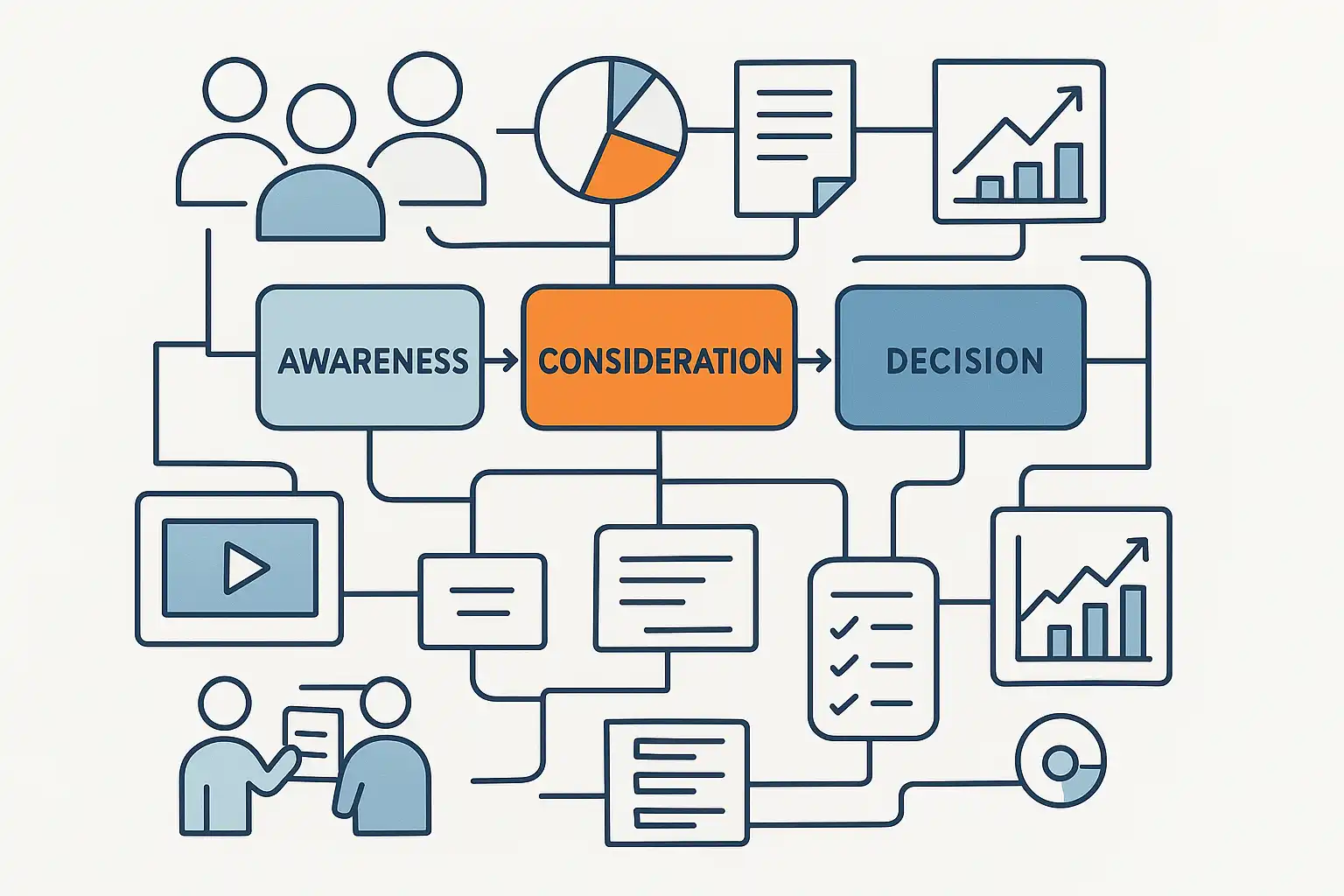
B2B purchases rarely happen overnight. Buyers move through distinct stages, and content that doesn’t align with these stages will miss opportunities or lose buyers to competitors.
Awareness: The buyer realizes they have a challenge or need. Content here should educate and help diagnose the problem — think blog posts, explainer videos, and industry reports. Gartner research shows that 61% of B2B buyers prefer a rep-free sales experience, meaning most of your audience will form their initial opinions through your content long before any sales conversation.
Consideration: Buyers are now exploring possible solutions, comparing options, and weighing risks. Content includes white papers, webinars, comparison guides, and expert articles that demonstrate thought leadership and depth.
Decision: The buyer is narrowing choices and needs reassurance. Content must offer proof — case studies, customer testimonials, ROI calculators, and product demos — to justify the final decision to all stakeholders involved.
Mapping your content to these stages keeps your brand relevant at every point. For a deeper look at how these phases shape your campaigns, this guide to the B2B buyer journey explained walks through each stage with practical examples.
Key components of a successful B2B content strategy framework
A strong framework is built from several essential elements working together:
- Clear, business-aligned goals. Set SMART goals — Specific, Measurable, Attainable, Realistic, Time-bound. For example: increase qualified leads by 20% in six months, or boost demo requests by a set number per quarter.
- Detailed buyer personas. Build profiles based on interviews with your sales team and real customers. Each persona should capture goals, pain points, preferred content formats, and decision-making criteria. Update these every six to twelve months as markets shift.
- Mapped buyer journeys. Lay out the stages each persona moves through. Where do they start? What questions do they ask at each stage? What content do they consume before making contact?
- Content audit. Take inventory of everything you currently have — blogs, case studies, guides, videos. Identify what performs well, where gaps exist, and what needs updating or removal.
- Consistent brand voice and style guide. Document your tone, messaging style, and any technical terms to use or avoid. This ensures consistent communication across your entire team.
- Content calendar and distribution plan. Schedule content month by month or quarter by quarter. Decide where each piece will live — website, social media, email, partner channels, or events — and align with product launches and campaigns.
- Performance measurement. Set up tracking from day one. Define the KPIs that matter and review them regularly.
How to customize content for different B2B decision-makers
One of the biggest challenges in B2B is that you’re rarely selling to just one person. Here’s how to address the diverse needs of your buying committee:
| Decision Maker | Preferred Content Format | Key Concerns |
|---|---|---|
| Technical Evaluator | White papers, case studies, technical FAQs | Features, security, compatibility |
| Business Executive | Strategic blogs, infographics, executive summaries | ROI, business value, competitive advantage |
| End User / Manager | How-to guides, demos, templates | Usability, support, quick wins |
| Finance / Procurement | ROI calculators, pricing comparisons, contract terms | Cost, risk, measurable return |
Example: If you sell cloud project management tools, your framework might address project managers (care most about features and integrations), IT directors (prioritize security and scalability), and finance teams (need clear ROI and cost comparisons). Each gets tailored content at each buying stage.

How to build your B2B content strategy framework — step by step
- Define your business and marketing goals. Ask: What do we want content to achieve? More leads? Higher brand awareness? Improved retention? Be specific.
- Research and document buyer personas. Interview real customers and frontline sales staff. Gather details about challenges, work roles, and decision triggers. This makes your content directly relevant rather than generic.
- Map the buyer’s journey. Draw out each stage from problem discovery to final purchase. For each stage, note the questions buyers ask and how they search for answers.
- Conduct a content audit. List all current blog posts, guides, videos, and other assets. Mark which perform well, which need updating, and which should be removed or redirected.
- Create a content plan and editorial calendar. Using your buyer research and journey map, brainstorm topics and formats that answer real audience needs. Assign ownership and publication dates.
- Document your processes and brand voice. Write down your preferred language, tone, and guidelines. Share them with everyone who creates or approves content.
- Measure and adjust regularly. Track results against your initial goals monthly or quarterly. Double down on what’s working and fix what isn’t.
For teams ready to formalize this process, organizing each stage with a clear framework to structure your content strategy makes the whole system easier to maintain and scale.
Essential B2B content types and their purposes
- Blog posts: Attract organic traffic, answer common questions, build topical authority.
- Case studies: Show real-world results and build trust with prospects evaluating your solution.
- Whitepapers and e-books: Educate buyers who want in-depth knowledge — often exchanged for contact information.
- Templates and checklists: Provide immediate practical value, encourage downloads and shares.
- Webinars and videos: Demonstrate expertise, explain complex solutions, engage audiences visually.
- Email newsletters: Nurture leads over time with regular, relevant updates tailored to their stage.
- ROI calculators: Help finance and procurement stakeholders justify the investment internally.
How to conduct a B2B content audit
- Collect all content assets in a spreadsheet or CMS.
- Review each item for accuracy, branding consistency, and relevance to current buyer personas.
- Analyze performance — which pieces generate leads, traffic, or meaningful engagement?
- Check SEO optimization — are titles, keywords, and meta descriptions aligned with how buyers actually search?
- Prioritize updates, rewrites, or removals based on identified gaps and future content needs.
How to measure B2B content strategy ROI
Key metrics to track:
- Engagement: Page views, time on page, social shares, comments, return visit rates.
- Lead generation: Form completions, content downloads, demo requests, event registrations.
- Conversion: How many leads turn into sales opportunities, and how many close. Attribute deals to specific content using tracking links or marketing automation.
- Content performance: Does a case study lead to more demo requests? Does an e-book drive webinar sign-ups?
- SEO results: Are you ranking for the keywords that matter to your buyers?
How to calculate ROI: Estimate total content costs (time, tools, freelancers) and compare to the number and value of leads generated. Even a simple comparison shows whether efforts are paying off over time. According to Content Marketing Institute research, marketers who measure performance effectively are dramatically more likely to report their content strategy as successful than those who don’t.
Tools to use:
- Google Analytics — page performance, traffic sources, user behavior
- HubSpot / Mailchimp — email performance, lead tracking, marketing automation
- SEMrush / Ahrefs — keyword rankings and content gap analysis
- Trello / Asana — content calendar and team workflow management

How to align sales and marketing in your B2B content framework
Sales and marketing alignment is one of the biggest opportunities in B2B — and one of the most commonly missed.
- Involve sales in the persona-building process. They have real-world insight into buyer objections and pain points that marketing often misses.
- Share content calendars and campaign plans so everyone knows what’s in the pipeline.
- Encourage sales to use content in their outreach — sending case studies, linking to guides, sharing relevant articles with prospects.
- Hold joint performance reviews to analyze which assets help move deals along and where bottlenecks occur.
This cooperation ensures your content planning workflow covers the entire buying cycle, from first touch to closed deal.
Common pitfalls and how to avoid them
- Creating content in silos: When marketing, sales, and product teams work independently, messaging becomes inconsistent. Schedule regular cross-functional collaboration.
- Focusing only on lead generation: Trust and brand awareness often matter as much as conversion. Build content that nurtures long-term relationships, not just quick wins.
- Neglecting to update content: Outdated case studies or pricing information damages credibility. Schedule regular content reviews.
- Ignoring all stakeholders: Don’t write only for one persona. Balance the diverse needs of everyone in the buying committee.
- Under-measuring results: Set clear KPIs from day one and review quarterly. Without data, improvement is guesswork.
Quick answers to your most common questions:
- How often to update your framework? Every six to twelve months — or sooner if goals, audience, or market conditions shift. Buyer personas especially go stale without regular input from real customer feedback.
- Do small teams need a framework? Yes. Even a simple written plan prevents wasted effort, keeps messaging consistent, and connects content to revenue when leadership asks.
- Limited resources? Start with blogs and case studies, use templates, outsource specific tasks, and add complexity only as your operation grows.
- Getting leadership buy-in? Lead with revenue attribution — show how content shortens sales cycles or generates leads, backed by comparable company examples.
- Tracking content influence on deals: Tag all links with UTM parameters, monitor asset engagement in your CRM, and ask sales to log what they share with prospects. HubSpot and similar tools make this considerably easier once the basics are in place.

Related Posts