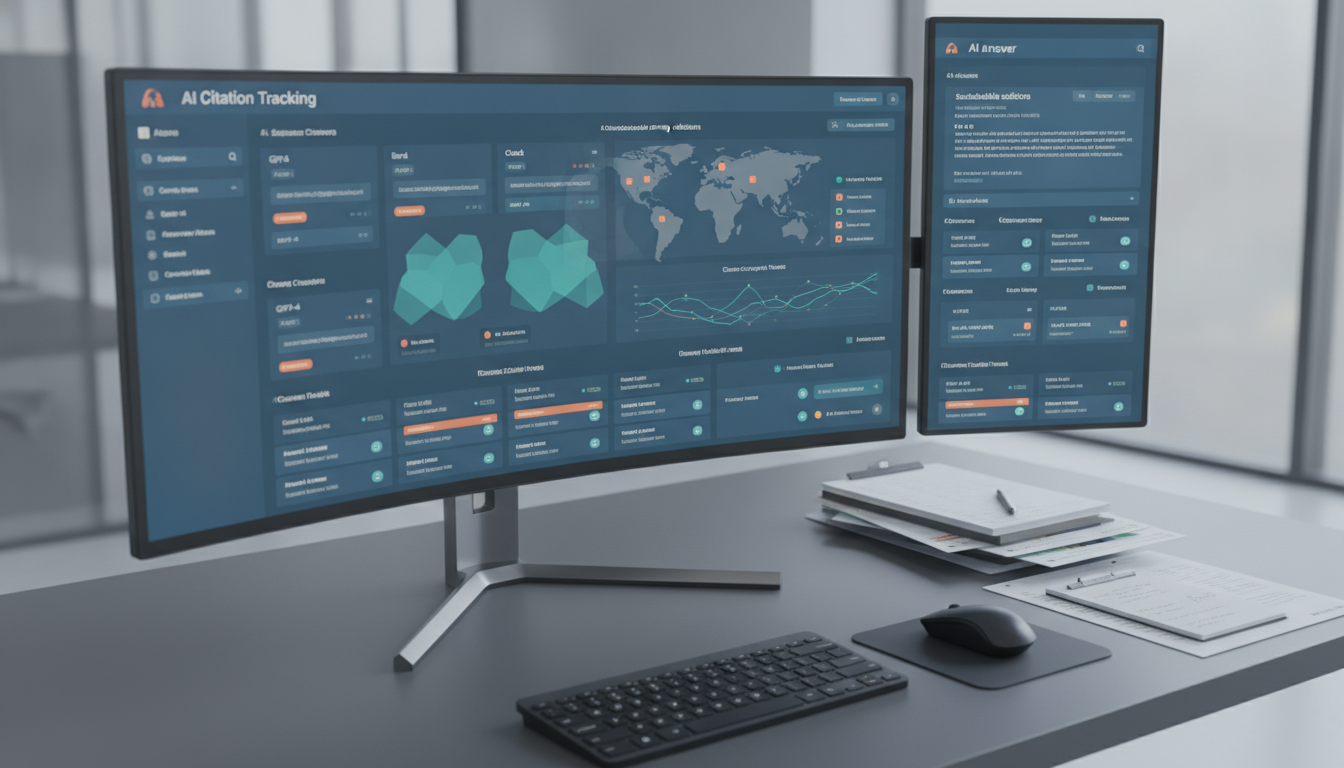
AI citation tracking answers a question that ordinary rank tracking cannot: when a person asks an AI system for advice, does your site appear as a visible source in the answer? A brand can rank well in traditional search and still be absent from AI-generated responses. Conversely, it can be cited frequently without receiving many clicks. Therefore, the only workable approach is to measure visible evidence, repeat the test, and connect the findings to content and business outcomes.
AI citation tracking measures whether an AI-generated answer mentions, links to, or visibly cites a website, page, organization, or source. For a useful program, separate three outcomes from the beginning: a brand mention, a visible source citation, and an AI referral visit. Although they overlap, they are not interchangeable.
Start with a practical definition of “being cited”
A citation is not simply proof that an AI system encountered your content. A system may retrieve a page, use information from it, and still show no source to the user. Conversely, a visible citation can support only one clause in a longer synthesized answer. Your AI answer source tracking should therefore record what was actually displayed, rather than what a tool estimates may have happened behind the scenes.
| Signal | What it proves | What it does not prove |
|---|---|---|
| Brand mention | The AI answer named your company, product, or domain. | Your site was linked, cited, or used as evidence. |
| Visible citation | A user could see a source URL, inline link, source card, or reference pointing to your page. | The citation supports the full answer or produced a click. |
| Retrieved but unshown source | Potentially, a tool or API reports that your content entered a retrieval set. | A user saw your source in the answer. |
| AI referral visit | A visitor arrived on your site from a detectable AI platform referral. | Your site was cited in answers that did not receive clicks. |
This distinction prevents a common reporting mistake: presenting a modeled visibility score as a count of user-visible citations. In fact, there is no industry-wide AI citation score. Each platform and vendor can use different prompts, indexes, retrieval methods, refresh schedules, and display conventions.
Build a minimum viable AI citation tracking program
A small team does not need thousands of prompts to get started. Instead, it needs a controlled sample that represents real buyer questions, repeated often enough to expose unstable results. In short, the goal is decision-quality evidence, not an impressive-looking dashboard.
Use 20 to 30 prompts for the first tracking set
For most small and mid-sized teams, begin with 20 to 30 prompts divided across the questions customers ask before, during, and after choosing a solution. Next, run each prompt three times per platform during the initial baseline. That creates 60 to 90 observations per platform, which is usually enough to see whether a citation is recurring or merely a one-off result.
- Discovery prompts: “What are the best ways to solve [problem]?”
- Comparison prompts: “Compare [category] options for [audience].”
- Problem-solving prompts: “How do I fix or improve [specific task]?”
- Trust prompts: “What should I look for when choosing [solution]?”
- Brand prompts: “Is [brand] suitable for [use case]?”
Do not fill the set with only branded prompts. Branded questions measure AI brand mention tracking and reputation accuracy, while non-branded prompts reveal whether your expertise is being surfaced before a user knows your name. If your team publishes educational material, connect the prompts to pages supported by your ai content planning process, so the tracking set mirrors topics you can realistically improve.
Test at least two AI environments
Choose the AI products your audience is most likely to use, then test at least two environments rather than treating one model as the market. One may be a search engine AI feature, while another is a conversational AI product with web sourcing. Their answers, source displays, and referral behavior can differ substantially.
For a fuller picture of how visibility is earned on individual platforms, see our guide on how to get your business cited in ChatGPT and Gemini.
Regarding geography, start with your primary market. Add one additional country or language only when you sell there, serve that audience, or already see meaningful regional differences in search behavior. Meanwhile, record country, language, device type, signed-in state, and date. Expanding geographically without a business reason generally creates more noise than insight.
Set a cadence you can maintain
Run the full prompt set monthly and repeat priority prompts weekly. Priority prompts are the five to ten questions tied most directly to high-value pages, leads, or purchases. Additionally, re-run a prompt immediately after a major content update, product change, or inaccurate AI statement about your business.
Above all, AI search prompt tracking requires consistency. Use the same wording for the baseline test, but maintain a separate variation set that changes phrasing naturally. A citation that survives several wording variations is stronger evidence of meaningful visibility than one that appears only for an exact query.
Capture evidence that can survive scrutiny
Good generative search citation monitoring is an audit trail. If another person cannot reproduce or inspect the result, then it should not drive a content decision.
- Open a clean browser session and document whether you are signed in.
- Enter the exact prompt and capture the full response, not only the source panel.
- Record every visible citation URL, the cited domain, citation placement, and the claim nearest to the citation.
- Save a screenshot or raw response export with timestamp, platform, market, language, and device details.
- Classify the result as visible citation, brand mention only, competitor citation, no citation, or unclear.
The key validation question is simple: could an ordinary user see a direct connection between the answer and your source? When the answer is yes, mark a visible citation. Suppose instead that a tool reports your page was retrieved, yet no link, card, or reference appeared in the observed answer; classify that as unshown retrieval. Finally, record a mention rather than a citation whenever the answer names your company without linking to it.
Commercial AI citation monitoring tools can accelerate collection, show historical patterns, and estimate AI citation share against competitors. Even so, use them as a screening layer instead of final proof.
For each important finding, open the recorded answer or reproduce the prompt manually. Then confirm the displayed URL, verify that it is your canonical page rather than a similarly named domain, and identify the exact claim it appears to support.
If you would rather run this loop in a dashboard than a spreadsheet, you can start tracking free with no card required.
Measure the signals that lead to decisions
AI search visibility metrics should answer operational questions: where are you absent, where are competitors winning, which cited pages contain weak information, and whether visibility produces qualified visits. Above all, avoid collapsing every signal into one score.
| Metric | Calculation or record | Useful decision |
|---|---|---|
| Citation presence | Number of test responses with at least one visible citation to your domain. | Identify prompts where your content is absent. |
| Prompt coverage | Share of target prompts that produce a visible citation across repeated runs. | Prioritize topic clusters with low representation. |
| AI citation share | Your visible citations divided by all tracked visible citations in the same prompt set. | Compare source visibility against named competitors. |
| Citation position | Whether your source appears inline, early in a source list, or only in an expanded panel. | Assess prominence, without assuming click volume. |
| Claim accuracy | Whether the nearby AI claim accurately represents your page, product, or policy. | Correct misleading or outdated source material. |
| AI referral traffic and conversions | Sessions, engagement, leads, and sales attributed to detectable AI referrals. | Evaluate commercial impact after visibility is established. |
Referral traffic must remain separate from citation frequency. For example, in an analysis of 68,879 Google searches by 900 U.S. adults, Pew Research Center found users clicked a link in an AI-generated summary in only 1% of visits when a summary appeared, even though 88% of those summaries cited three or more sources.
That gap changes how to interpret AI referral traffic tracking. Analytics and server logs can confirm clicks and conversions, but they cannot count citations viewed without a click. Consequently, a page may show strong citation presence alongside modest referral traffic, because users received enough information from the answer itself. Treat that outcome as a visibility and authority result, not automatically as a traffic failure.
Turn citation findings into content actions
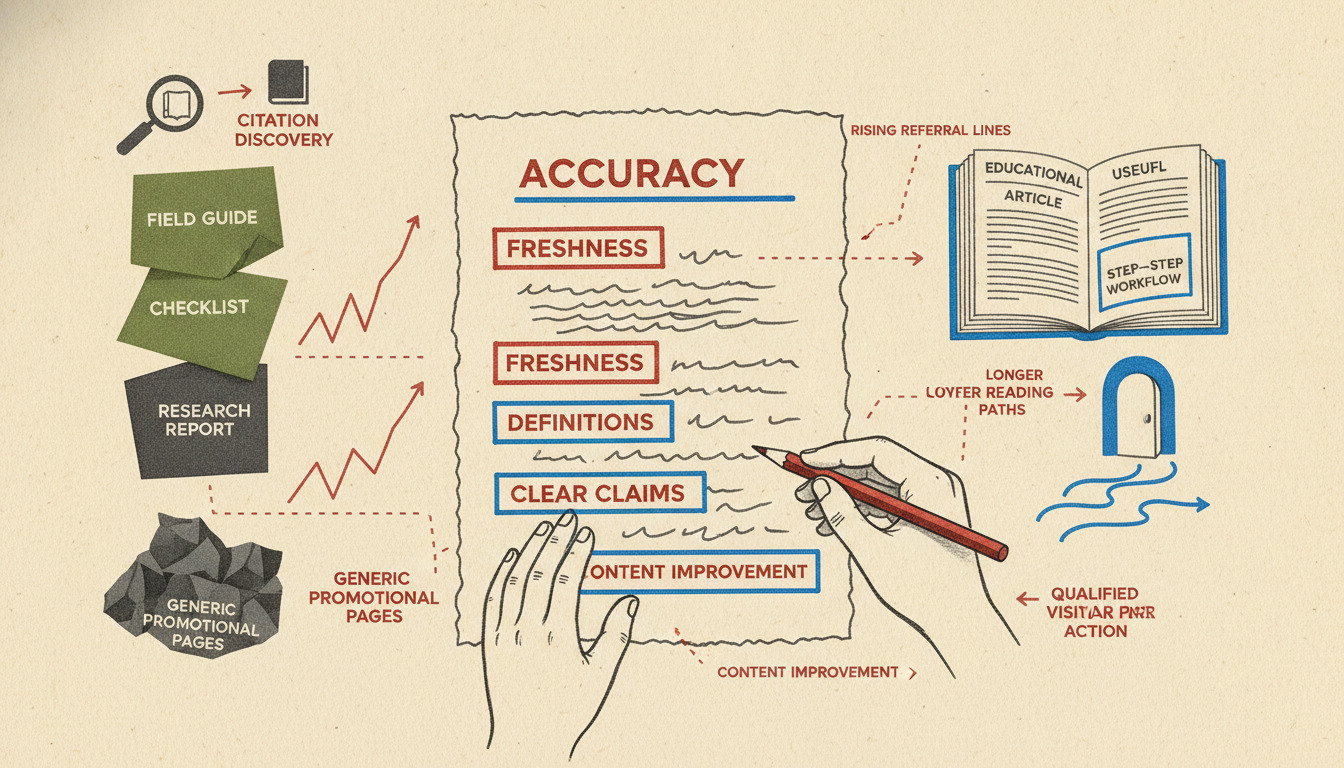
The value of AI-generated answer source analysis comes from the action taken after review. Every high-priority citation should be checked for accuracy, freshness, and page quality. Similarly, every important missing citation should become a hypothesis about what the answer needed but did not find on your site.
When you are cited but the AI answer is wrong
Review the cited page first. Tighten ambiguous language, update outdated details, add precise definitions, and make key claims easy to locate. If the answer repeatedly misstates pricing, eligibility, product capabilities, or instructions, then place the corrected statement prominently on the relevant page. However, do not attempt to “optimize” through unsupported claims, because AI systems can amplify unclear content as easily as useful content.
When competitors are cited instead
Compare the competitor source type with your own. The cited result may be a guide, documentation page, review, directory listing, research source, or an authoritative third-party publication. Your response should therefore match the information gap. Creating another generic article rarely beats a competitor that offers a clearer answer, current evidence, and an accessible page structure.
For example, a team that sees repeated citations for “how to create a content workflow” might improve a practical guide, template, or step-by-step resource instead of publishing promotional copy. Useful resources built alongside ai content creation tools can answer the task directly, while giving AI systems clearer material to associate with the query.
When citations increase but business results do not
Check landing-page intent before judging the citation program. A cited educational page may attract researchers rather than buyers. Therefore, add a relevant next step, ensure the page loads and explains the offer clearly, and review conversion paths for AI-referred visitors.
Adobe Analytics reported that generative-AI referrals to U.S. retail sites rose 1,200% from July 2024 to February 2025. Notably, those visitors also showed lower bounce rates and longer time on site than non-AI visitors in February.
That retail finding does not guarantee similar performance for every business. Still, it supports measuring AI referrals carefully instead of dismissing them as trivial. Use tagged links where you control them, inspect referral sources in analytics, and finally compare conversion quality with other channels over time.
Choose the right evidence source for each job
No single method can verify every platform and outcome. For that reason, a durable AI search visibility monitoring program combines evidence sources according to the decision at hand.
- Manual browser checks: Best for confirming what users can actually see. Use them for priority prompts and tool validation.
- Official APIs: Useful when a platform provides structured citation metadata and reproducible requests, although they may not reflect every consumer interface.
- Commercial monitoring platforms: Suited to scale, trend detection, and competitive comparison. Validate important results, because collection methods are proprietary.
- First-party search reporting: Helpful for visibility within a specific search engine’s AI feature. However, it is not a cross-platform citation database.
- Analytics and server logs: Reliable for confirmed visits, engagement, and conversions, yet unable to reveal unclicked citations.
If resources are tight, use manual checks for the 10 highest-value prompts, a spreadsheet for evidence, and analytics for referral outcomes. Add AI citation monitoring tools only when manual work prevents regular testing, or when competitor and historical analysis becomes necessary.
Teams producing frequent educational assets can also use ai content marketing tools to keep source pages updated. Even so, publishing speed should never replace claim review.

Make AI citation tracking a content-quality discipline
The strongest AI citation tracking program is not a hunt for a universal score. Rather, it is a repeatable way to observe visible citations, distinguish them from mentions and referrals, and improve the pages that shape AI answers. To begin with, start with 20 to 30 representative prompts, test them repeatedly across two relevant AI environments, and preserve evidence for every meaningful result.
Then make the work accountable. Tie each citation finding to a page owner, a claim-accuracy check, a content update, and—where clicks occur—an analytics outcome. Ultimately, that turns AI citation tracking from a vague visibility report into a disciplined loop: observe what users see, verify the source, improve the information, and test again.

Related Posts