
A content marketing strategy template is only useful if it helps you decide what to publish next, where to distribute it, who owns each step, and how you will know whether it worked. That sounds obvious, yet CMI’s B2B Content Marketing Trends 2025 found that only 40% of B2B marketers say they have a documented content marketing strategy. The gap is not awareness. It is operational clarity.
This article is built for action. If you are starting from zero, rebuilding a messy plan, or trying to turn a vague content strategy template into something a team can actually use, you will leave with a working framework, a lightweight version for small teams, decision rules for filling out each section, and examples you can adapt immediately.
What a content marketing strategy template actually does
A content marketing strategy template is a documented framework for deciding who content is for, why it is being created, what will be published, where it will be distributed, and how success will be measured. That definition matters because many teams confuse strategy with execution.
Content strategy sets direction and governance. Content marketing is the implementation: briefs, drafts, campaigns, distribution, and optimization. If your template only contains a content calendar template and a list of blog ideas, you do not yet have a strategy. You have production planning.
- Strategy answers: Which business goal matters most right now?
- Planning answers: Which topics, formats, and channels support that goal?
- Execution answers: Who creates, approves, publishes, and promotes each asset?
- Measurement answers: Which content KPIs prove progress?
The strongest templates create a line from business objective to audience need to content format to channel to metric. If any one of those links is missing, the template becomes decorative instead of useful.
The working framework: fill out the template in this order
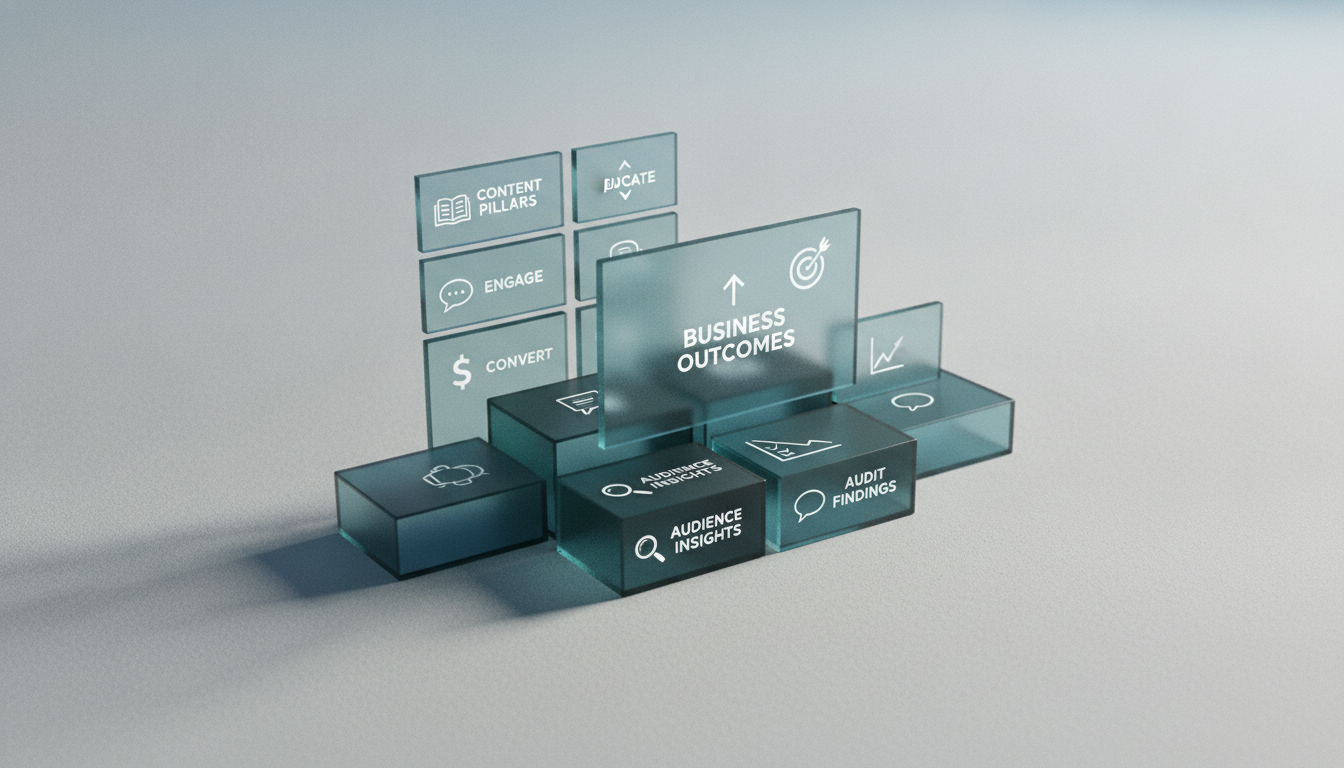
Most articles list the parts of a template. That is not enough. The order matters because each field depends on the previous decision. Fill it out in sequence and the later sections become easier and more accurate.
- Business goal and content objective
- Audience and buyer journey stage
- Current-state audit
- Content pillars
- Formats and channels
- Workflow and governance
- Measurement and review cadence
1. Start with one business outcome, not a broad mission statement
Effective strategy starts with a business goal. Pick the primary objective your content should support over the next planning period: brand awareness, lead generation, customer retention, sales enablement, or thought leadership. Do not select all five. One primary objective creates focus; secondary objectives can still exist, but they should not drive the template.
Use a simple rule: if a proposed content idea would still be approved even if it did nothing for your main goal, the goal is too vague. A lead-generation program and a customer-retention program require different topics, formats, and CTAs. Your content marketing plan template should force that distinction early.
2. Define audience by decision context, not demographics alone
A useful audience section goes beyond job title or age range. It should document pain points, needs, motivations, objections, and buyer journey stage. This is where teams usually produce generic persona language and then wonder why the content feels interchangeable.
Instead, write audience notes in a way a writer can use. “Marketing manager” is not enough. “Marketing manager at a lean B2B team who needs a simple approval process, struggles to maintain publishing consistency, and is comparing Notion, spreadsheets, and project-management tools” is much better. If you need a clearer starting point, this guide to audience research in media is a practical companion to the audience section of your template.
Then map those needs to buyer journey content:
- Awareness: educational explainers, trend analysis, introductory videos
- Consideration: comparisons, case-study style proof, webinars, templates
- Decision: product walkthroughs, implementation guides, sales-enablement assets
- Retention: onboarding content, advanced how-tos, customer newsletters
3. Do the audit, even if you think you have nothing
A content audit template is not only for mature teams with years of published assets. It is the step that keeps you from producing duplicates, ignoring strong legacy pages, or chasing topics that already failed for a reason.
Your audit should identify:
- Existing assets by format and channel
- High-performing content
- Topic gaps
- Outdated pieces to update, merge, redirect, or remove
- Missing assets at specific buyer journey stages
If you are starting from zero and do not have a real archive, do a “zero-based audit” instead. List what already exists across sales decks, onboarding docs, webinar recordings, founder posts, product FAQs, support tickets, and email sequences. A company can have no formal blog history and still have useful source material. That inventory becomes your first audit baseline.
4. Choose content pillars your audience will actually return for
Content pillars are the recurring subject areas your brand will cover. They should be tied to audience relevance and search opportunity, but also to credibility. A common mistake is choosing pillars based on what the company wants to say rather than what it can sustain with authority.
A good test is to ask three questions:
| Pillar test | What to check | Keep or cut? |
|---|---|---|
| Audience pull | Does the topic solve a repeated problem or support a repeated goal? | Keep if demand is ongoing |
| Business fit | Can this pillar support your chosen objective such as leads or retention? | Keep if it moves a business outcome |
| Operational depth | Can your team produce multiple useful assets on the topic? | Cut if it only supports one-off content |
For example, a SaaS brand might use pillars such as workflow automation, team planning, reporting, and governance. A media team managing several sub-brands might need a more segmented structure, which is where a content plan template for multiple brands becomes useful if one strategy has to support different audiences without collapsing into one giant spreadsheet.
How to build the simplest version for a small team
Not every team needs a heavyweight content marketing framework on day one. Small teams usually fail by overbuilding governance, adding too many metrics, and creating a process no one has time to maintain. A lean template works better if it still captures the essential decisions.
The five-field minimum viable template
If you have one marketer, a founder, and occasional freelance support, start with just five fields:
- Primary business goal
- One target audience segment
- Three content pillars
- Two core formats and two distribution channels
- Three KPIs tied to the goal
That is enough to make useful decisions without drowning in administration. For workflow, keep it visual and basic: Content Marketing Institute’s governance guidance notes that a documented editorial workflow can be as simple as a flowchart showing the people and tasks in the content life cycle. That is the right starting point for a small team.
What small teams should not document yet
Skip complex scoring models, multi-touch attribution logic, and channel-by-channel governance documents until your publishing cadence is stable. Early-stage teams benefit more from consistency than sophistication. If you cannot publish and distribute reliably for eight to twelve weeks, more fields in the template will not fix the underlying problem.
Keep role ownership clear, though. Even a lean content workflow needs named responsibility for ideation, drafting, review, approval, publishing, and promotion. “Shared by the team” usually means “owned by no one.”
How to fill each section with real answers
This is the point where many templates become abstract. The easiest way to avoid that is to write every field so it can guide a weekly decision. If a field cannot help someone approve, reject, prioritize, or measure content, rewrite it.
Goals section example
Weak: “Grow awareness and leads.”
Stronger: “Primary objective for the next quarter is lead generation from mid-funnel educational content for operations managers evaluating planning software.”
The second version tells you what kind of content to prioritize and what to decline.
Audience section example
Weak: “SMB marketers.”
Stronger: “Lean B2B marketing teams with limited design and editorial resources, needing a repeatable process more than advanced campaign complexity.”
That audience statement would naturally support topics like lightweight workflows, templates, and tool comparisons, including a discussion of Notion vs Asana for content planning when the user is trying to match process complexity to team size.
Formats and channels section example
Do not list every channel you have access to. Choose the ones that suit both audience behavior and operational reality.
| Objective | Best-fit formats | Likely channels |
|---|---|---|
| Brand awareness | Blog posts, videos, newsletters | Website, email, organic social |
| Lead generation | Guides, webinars, case studies, templates | Website, email, landing pages, organic social |
| Sales enablement | Comparisons, one-pagers, demos, objection-handling content | Website, email, sales follow-up |
This is where your content distribution strategy belongs. Distribution should be planned in the template, not improvised after publication. If your team is choosing between workflow systems for managing that publishing cadence, a Trello vs Airtable content calendar comparison can help you decide how to organize campaign visibility versus database flexibility.
Measurement section example
Match metrics to the goal. Traffic is not the universal answer.
- Brand awareness: impressions, reach, engaged sessions, newsletter growth
- Lead generation: conversions, leads, assisted signups, qualified inquiries
- Retention: repeat visits, product adoption content engagement, renewal-related signals
- Sales enablement: asset usage, influenced opportunities, follow-up engagement
If a KPI cannot reasonably change because of content, remove it from the template. Revenue may matter, but for many teams it is too downstream to serve as the only operating metric.
Review cadence: when to update the template so it stays useful
A content marketing strategy template should not be rewritten every week, but it should be reviewed on a set cadence. Otherwise it becomes a slide deck people mention and ignore.
Use three layers of review:
- Monthly: check content KPIs, distribution performance, and workflow bottlenecks
- Quarterly: reassess goals, audience priorities, content pillars, and channel mix
- Event-driven: update immediately after a major product shift, positioning change, team restructure, or market change
The monthly review is operational. The quarterly review is strategic. That distinction keeps the template stable enough to guide execution but flexible enough to stay relevant. If your priorities have changed and the template still points to old audience pain points, it is not a strategy asset anymore; it is stale documentation.

A complete example you can adapt this week
Here is a compact example of a content strategy template filled out in practical terms. Use it as a model, not a script.
| Section | Example entry |
|---|---|
| Business goal | Generate qualified demo interest from operations leaders over the next quarter |
| Audience | Operations leaders at growing teams who need clearer planning processes and simpler reporting |
| Pain points | Scattered planning, inconsistent approvals, unclear ownership, weak visibility into deadlines |
| Content pillars | Planning workflows, governance, reporting, tool selection |
| Formats | How-to blog posts, comparison pages, case-study style articles, webinar recaps |
| Channels | Website, email newsletter, LinkedIn organic posts |
| Workflow | Strategist briefs, subject-matter review, editor approval, scheduled publish, same-week distribution |
| KPIs | Organic conversions, email signups, assisted demo requests, engagement on comparison content |
Notice what is missing: no inflated channel list, no vanity goals, no universal KPI stack. A useful content marketing strategy template is selective. It narrows choices so the next month of content becomes easier to plan.
Where this template earns its keep
The test of a template is not whether it looks complete. It is whether it helps you say no, spot gaps, and coordinate people. When a proposed article idea appears, the template should tell you whether it fits a pillar, supports the current business goal, targets the right buyer journey stage, and has a clear distribution path. If it fails those checks, reject it or rework it.
That is why the strongest templates are not the longest ones. They are the ones a team revisits during planning, briefing, publishing, and review. If you build one this week, keep it lean enough to use and specific enough to govern decisions. A content marketing framework that lives in practice will outperform a more elaborate one that nobody opens.
Start with one objective, one audience segment, three content pillars, a basic content workflow, and a short list of measurable outcomes. Then review it monthly, sharpen it quarterly, and let actual publishing data refine the rest. That is how a content marketing strategy template becomes an operating system instead of a worksheet.

Related Posts