Understanding what content to create at each step of the buyer journey can make the difference between a lead that converts and one that walks away. Content that’s too promotional too early pushes people away. Content that’s too shallow at the decision stage fails to close. The key is matching the right message, format, and tone to where your buyer actually is.
This guide covers every stage of the buyer journey, which content types work best at each, real-world examples across industries, how to tailor content to buyer intent, and how to measure what’s working.
The three main stages of the buyer journey
The buyer journey moves through three primary stages, each reflecting how close someone is to making a purchase:
- Awareness (Top of Funnel — TOFU): Buyers realize they have a problem or need and start searching for information. They may not know your brand yet. Content should be helpful, educational, and easy to digest — never salesy.
- Consideration (Middle of Funnel — MOFU): Buyers are now aware of their problem and actively researching solutions. They’re comparing options — including your competitors. Content should be more detailed and prove your value without forcing a decision.
- Decision (Bottom of Funnel — BOFU): Buyers want reassurance. They’re close to purchasing but need confidence that they’re making the right choice. Content must remove final doubts and make taking action easy.
What content works best at each stage
Awareness — Educate and Attract
At this stage, focus on broad, educational content that addresses the problem — not your brand.
Best formats:
- Educational blog posts answering common questions
- White papers and eBooks — long-form guides that position your brand as a thought leader
- Analyst reports — third-party validation and market trend data
- Infographics and quick-tip visuals
- How-to guides and checklists
- Short videos and social media content
- Research reports with industry statistics
Example: A cloud security company publishes a white paper explaining current cyber threats — educating the market without pitching a product.
Consideration — Engage and Provide Solutions
Here, buyers seek more detailed information and begin comparing solutions. Content should prove your value and help them evaluate options.
Best formats:
- Comprehensive buying guides with side-by-side comparisons
- Case studies showing real results
- Webinars and expert interviews
- Demo videos and product walkthroughs
- Email courses — step-by-step lessons delivered over time
- Comparison tables
- Blog series diving deep into features and benefits
- Product comparison sheets and FAQs
Example: A SaaS company invites leads to a live webinar walking through platform features and answering audience questions in real time.
Decision — Convert and Reassure
Buyers at this stage want confidence. They need social proof and final reassurance that your solution is the right choice.
Best formats:
- Case studies with specific, measurable results
- Customer testimonials and reviews
- Comparison guides (honest comparisons against competitors)
- ROI calculators — interactive tools to estimate potential value or savings
- Free trials or product samples
- Live or personalized product demos
- Personalized consultations
- Product user guides helping buyers imagine onboarding and success
Example: A case study showing how a client doubled efficiency with your tool provides social proof that closes deals at this stage.
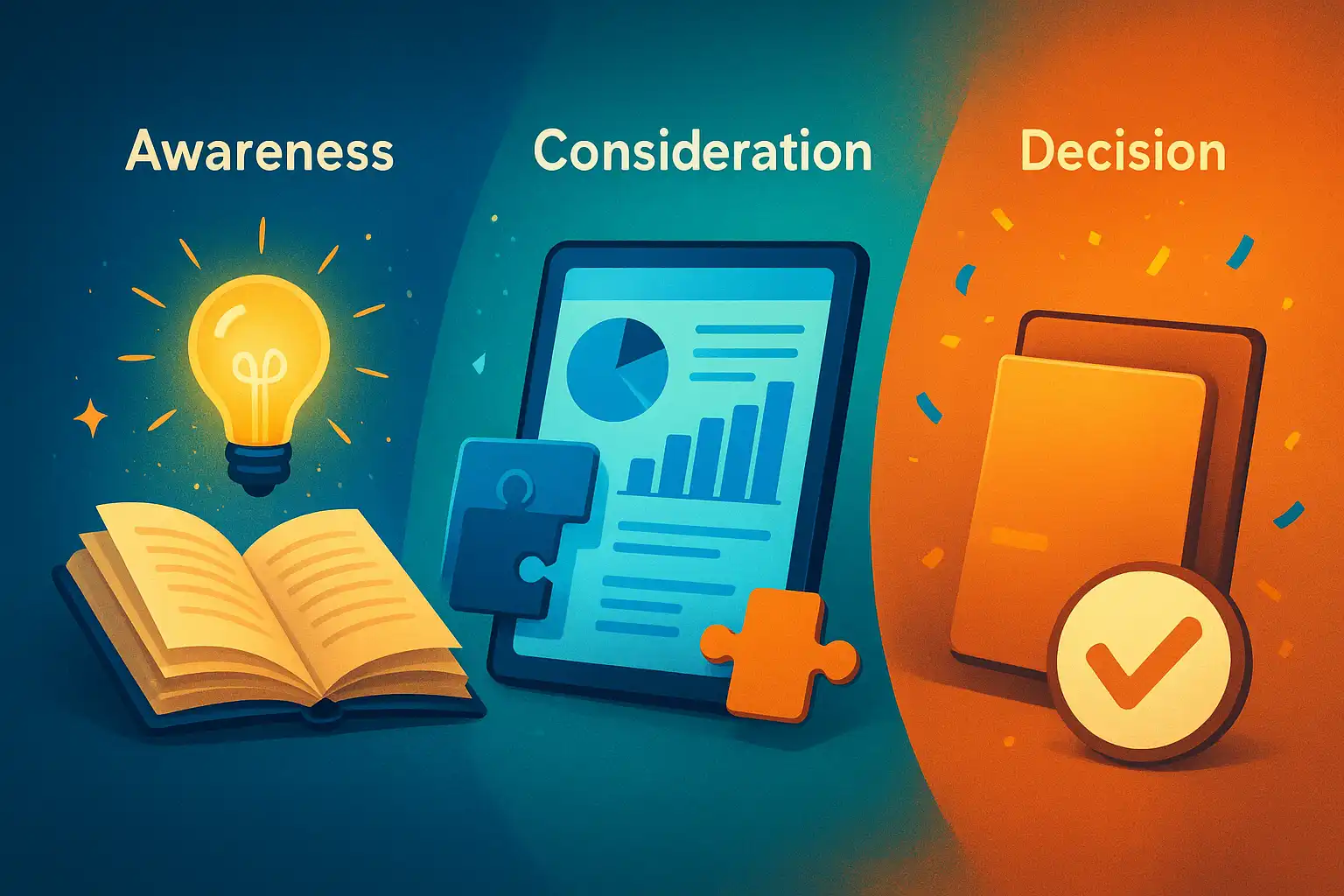
How content changes across funnel stages — at a glance
| Stage | Buyer Mindset | Content Tone | Goal |
|---|---|---|---|
| Awareness | “I have a problem” | Educational, broad, helpful | Attract and inform |
| Consideration | “I’m researching solutions” | Technical, comparative, detailed | Engage and prove value |
| Decision | “I’m ready to choose” | Reassuring, social proof-heavy | Convert and close |
HubSpot’s research on the modern buyer’s journey shows that when buyers experience strong alignment between a supplier’s website and their sales conversations, they are 2.8 times more likely to close a high-quality deal — confirming that content and sales teams working from the same playbook creates a measurable advantage.
Real-world content examples by industry
| Stage | Industry | Example Content |
|---|---|---|
| Awareness | Software | eBook: “5 Trends in Project Management” |
| Awareness | Fitness | Blog: “How to Start Working Out for Beginners” |
| Consideration | Healthcare | Webinar: Live demo of patient portal tools |
| Consideration | B2B Software | Guide: “Compare the Top 5 Project Management Tools” |
| Decision | eCommerce | Case study: “Increased sales by 45% using new platform” |
| Decision | Cloud Accounting | Free 14-day trial + video testimonials |
A digital marketing agency might use a blog post for awareness, a downloadable audit checklist for consideration, and client testimonials for conversion — each piece serving a distinct purpose. For a deeper look at the strategy behind these choices, this overview of matching content formats to buyer intent walks through the approach step by step.
How to tailor content to buyer intent at every stage
- Awareness: Answer high-level questions and introduce possibilities. Use Ideal Customer Profiles (ICP) or Target Account Lists to know who you want to reach. Keep messaging problem-focused, not product-focused.
- Consideration: Personalization becomes critical. Analyze engagement data — which emails are opened, what’s clicked, which webinars are attended — and adjust your messaging to match each prospect’s specific concerns.
- Decision: Give prospects everything they need to feel certain. Testimonials, detailed product comparisons, one-on-one demos, ROI calculators, and access to pre-sales support all help break down the final barriers to purchase.
How to build a content plan mapped to the funnel
- Identify your customer’s questions at each stage. What are they asking? What are they searching for? What objections do they have?
- Select content formats that fit. Top of funnel: educational and visually engaging. Middle: deeper guides, webinars, proof points. Bottom: trust-builders like testimonials and demos.
- Reuse and repurpose top-performing content. Turn a popular blog post into an infographic, a short video, or an email series.
- Align sales and marketing. Ensure both teams understand which content is available at each stage and use it consistently in outreach and follow-up.
- Track and iterate. Monitor which content moves buyers forward and update regularly as buying behaviors evolve.
Common mistakes to avoid
- Pushing sales content too early — don’t pitch products at the awareness stage; focus on education first.
- Ignoring persona differences — generic content fails to address the specific concerns of different buyer types.
- Not updating your content — outdated case studies, guides, and webinars erode credibility.
- Misaligning sales and marketing — if both teams aren’t using the right content at the right time, leads fall through the cracks.
- Skipping interactive content at consideration — assessments, calculators, and quizzes increase engagement and provide valuable data for personalization.
To keep your approach current with evolving digital touchpoints and buyer behaviors, these practical tips for optimizing buyer journey content on digital platforms offer specific tactical guidance for each stage.
For a broader framework that connects buyer journey thinking to your overall marketing system, exploring planmoon’s content planning resources shows how to coordinate content efforts across teams and channels.
Key Notes on Funnel-Based Content Strategy

Related Posts