
An AI content strategy framework is a clear system for deciding what content to create, why it matters, who it serves, and how to produce it consistently with AI support. It helps teams connect content to business goals, choose high value topics first, and scale output without losing quality. If you want better planning, smarter prioritization, and repeatable growth, this framework is the practical starting point.
Many teams rush into AI tools before they set rules, goals, and workflows. That often leads to thin articles, duplicated efforts, and weak results. A better approach starts with strategy. When you define principles, assign roles, measure outcomes, and build a simple process, AI becomes useful instead of chaotic. The goal is not to publish more for the sake of volume. The goal is to publish content that earns attention, trust, and action.
What is an AI content strategy framework?
An AI content strategy framework is a structured way to manage content with AI across planning, creation, review, distribution, and improvement. Think of it as an operating system for your content team. It gives everyone shared rules, priorities, tools, and targets.
This matters because AI can speed up research, outlines, drafts, summaries, and optimization. Still, speed alone does not create value. Without direction, teams produce content that sounds fine but misses user intent, brand voice, and business goals. A framework solves that problem by keeping every decision connected to a larger plan.
It also supports AI content strategy business alignment. Marketing, sales, product, and leadership can work from the same priorities instead of pulling in different directions. That alignment makes budgets easier to defend and results easier to explain.
Why do businesses need a framework before they scale?
Scaling without a framework usually creates three problems. First, content quality becomes uneven. Second, teams waste time rewriting or reviewing weak drafts. Third, leaders lose confidence because they cannot see a reliable return.
A framework reduces those risks. It sets quality standards, approval steps, and success metrics before production expands. It also balances innovation with governance, which means your team can test new ideas without creating legal, ethical, or brand problems.
Large brands already use this thinking. Companies like HubSpot, Adobe, and Salesforce invest in processes, not just tools. They know repeatable systems beat one off experiments. Smaller teams can use the same lesson. You do not need enterprise complexity. You need a plan that is simple enough to use every week.
The seven essential parts of an effective framework
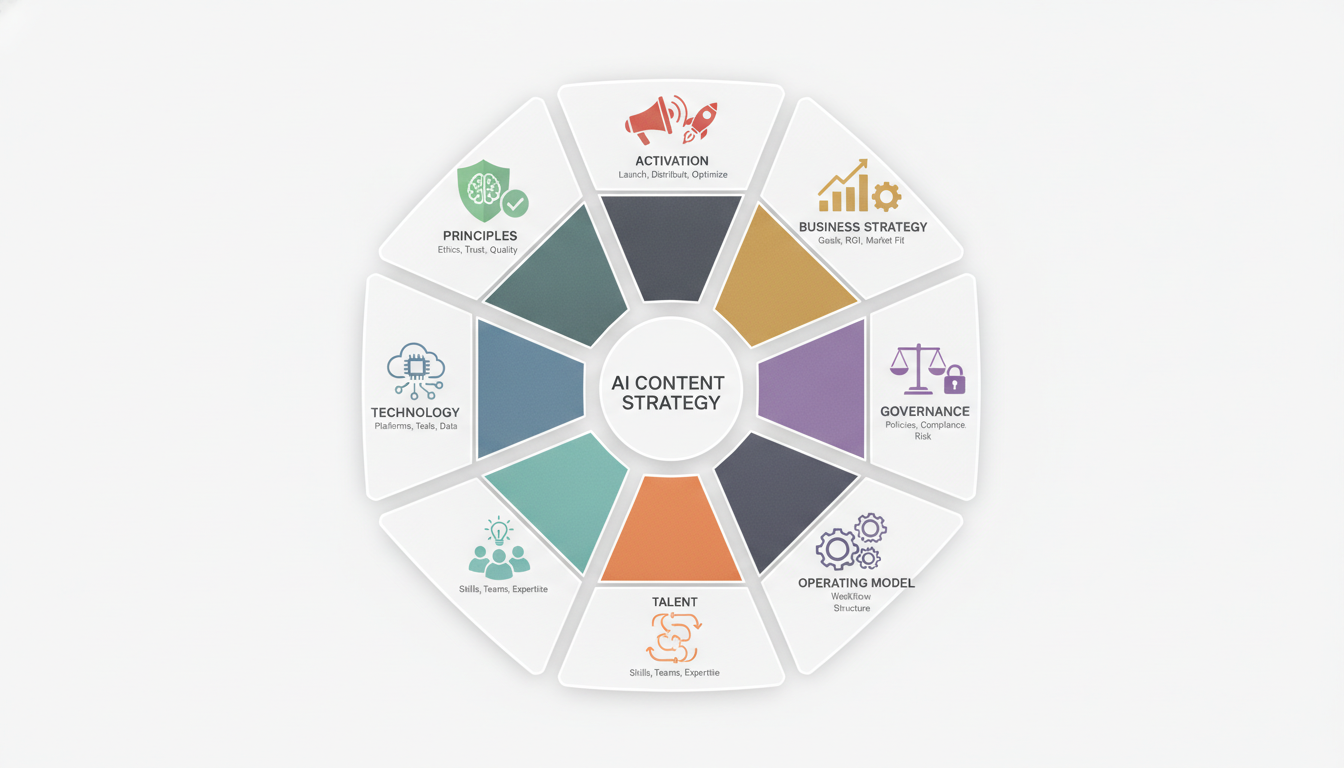
The strongest models share several core parts. A practical version of the effective AI content strategy framework components includes principles, business strategy, governance, operating model, talent, technology, and activation. Together, these parts turn ideas into reliable output.
1. Principles
Principles are the values behind your content program. They include hard goals like revenue, leads, and retention, plus soft goals like quality, transparency, safety, and trust. These standards guide how AI is used and where humans stay in control.
2. Business strategy
This part connects content work to company priorities. Define the mission, expected outcomes, key audiences, and ROI measures. If your business wants more qualified pipeline, your content should support that goal directly.
3. Governance
Governance sets the rules. It covers review policies, disclosure standards, data use, brand voice, and risk checks. Good governance protects the brand without slowing useful work.
4. Operating model
Your operating model is how work gets done. It defines roles, handoffs, editorial calendars, workflows, and best practices. This is where scaling content production in AI framework becomes realistic instead of aspirational.
5. Talent
AI does not remove the need for skilled people. Teams still need editors, strategists, subject experts, and analysts. Talent planning should include training, literacy benchmarks, and selective hiring.
6. Technology
Technology choices should solve real workflow gaps. Useful tools may include ChatGPT, Claude, Jasper, Grammarly, Surfer, Notion, Asana, Airtable, and analytics platforms like Google Analytics 4. Pick tools that fit your process, not tools that create extra complexity.
7. Activation
Activation turns strategy into action. It includes communication, stakeholder buy in, roadmaps, milestones, and launch plans. This is the part that keeps a framework from sitting in a slide deck.
How do you plan content with AI in a practical way?
Planning starts with user needs and business goals, not prompts. Begin by listing your audience segments, the questions they ask, and the outcomes your company wants. Then use AI to speed up research, cluster topics, and outline content paths.
- Set one primary business goal for the quarter.
- Map audience pain points to funnel stages.
- Group keywords into topic clusters and intent buckets.
- Choose content formats such as blogs, landing pages, emails, or case studies.
- Create briefs with target reader, search intent, angle, and call to action.
- Use AI for outlines and draft support, then apply human review.
This method keeps the AI content strategy framework grounded in purpose. It also helps teams avoid random publishing. Every article, page, or campaign should have a clear reason to exist.
How should teams prioritize content creation?
Prioritizing content creation with AI strategy works best when you score each idea against value and effort. Value includes revenue influence, audience demand, strategic fit, and repurposing potential. Effort includes research time, expert input, production cost, and review risk.
A simple scoring model is enough for most teams. Rate each idea from one to five on business impact, search opportunity, customer relevance, and production ease. Then focus on content with strong impact and manageable effort. This prevents teams from spending weeks on low value topics just because they are interesting.
Use AI to speed up the comparison. It can summarize market questions, compare search themes, surface content gaps, and suggest supporting angles. Still, final decisions should stay with humans who understand revenue priorities and brand nuance.
- Prioritize high intent topics first.
- Prefer reusable content over one off pieces.
- Support sales and customer success with practical assets.
- Balance quick wins with long term authority topics.
What does a scalable content workflow look like?
Scaling requires consistency. A strong workflow usually has five stages: research, brief, draft, review, and distribution. AI can support each stage, but the rules should be clear before output increases.
In research, AI helps collect questions, summarize competitors, and spot patterns. In briefing, it helps organize goals, sources, and structure. In drafting, it creates a first version quickly. During review, editors check facts, tone, originality, and usefulness. In distribution, AI can adapt the core asset into social posts, emails, snippets, and sales enablement pieces.
The operating model should also define who owns each step. For example, a strategist approves topics, a writer shapes the draft, an editor protects quality, and a subject expert verifies claims. Clear ownership is one of the most overlooked parts of technology and talent in AI content strategy.
How can you maintain quality while publishing more?
Quality control starts with standards. Create a checklist for accuracy, clarity, originality, readability, search intent, and brand voice. Give AI the same structured prompts and source rules each time, then review every draft before publication.
It helps to build reusable templates for common content types. A blog brief, product page, webinar recap, and case study should each have a standard structure. Templates reduce guesswork and make editing faster.
You should also track quality signals after publishing. Watch engagement time, conversion rate, bounce patterns, assisted revenue, and refresh needs. If a page ranks but does not convert, the issue may be weak messaging. If it converts but does not rank, the issue may be discoverability. Improvement becomes easier when measurement is tied to each asset.
Tools, teams, and metrics that support growth
Useful tools support different layers of the framework. Research tools find topics. Writing tools speed production. Workflow tools keep tasks moving. Analytics tools show what worked. No single platform does everything well, so choose based on need.
Teams should stay cross functional. Marketing owns the editorial direction, but product experts, sales teams, legal reviewers, and data analysts all shape stronger output. That collaboration reduces rework and increases trust.
Metrics should match business outcomes. Track leading indicators like publishing velocity, time to draft, and content refresh rate. Then track business results like qualified leads, pipeline influence, assisted conversions, and retention impact. This is how leaders see whether AI content strategy business alignment is actually happening.
Common mistakes to avoid
One mistake is treating AI as a replacement for strategy. Another is publishing drafts without expert review. Teams also fail when they chase too many tools, ignore governance, or measure only traffic.
Avoid these traps by starting small and documenting what works. Pilot one workflow, train the team, and improve the process before expanding. Simple systems usually scale better than complicated ones.

FAQ
How long does it take to build an AI content framework?
Most teams can build a useful first version in two to six weeks. Start with goals, roles, workflow, and quality rules, then improve from real use.
Can small businesses use an AI content strategy framework?
Yes. Small teams often benefit the most because a framework helps them focus limited time and budget on content that has the best chance to drive results.
Should every piece of AI assisted content be reviewed by a human?
Yes, especially for brand, legal, medical, financial, or technical topics. Human review protects accuracy, tone, trust, and usefulness.
What is the best first step if our content process is messy?
Pick one business goal, define one audience, and create one repeatable workflow. A simple, documented process is the fastest path to better planning, prioritization, and scale.

Related Posts